Posts · Physics
Watching Can Hide an Arrow of Time, Never Invent One
A loop that runs clockwise nine times in ten looks perfectly reversible if you only watch whether its position is odd or even. The reverse mistake is impossible for an honest observer. It is easy for a model, a solver or an estimate.
Run a film of a cup shattering backward and you know at once that something is wrong. Run a film of a pendulum backward and you may not. One way to make that difference precise is to compare probabilities: how likely is each possible history of a system, and how likely is the same history played in reverse? If every history is exactly as likely as its reverse, the forward and backward films cannot be told apart, and the process has no arrow of time. The more the two sets of probabilities differ, the stronger the arrow.
Several papers in the Six Birds series behind this site measure the arrow this way, with a standard score of how far apart two sets of probabilities are, called relative entropy. They use it to ask a simple question. If you watch a system less closely, what happens to its arrow?
A loop that hides its arrow
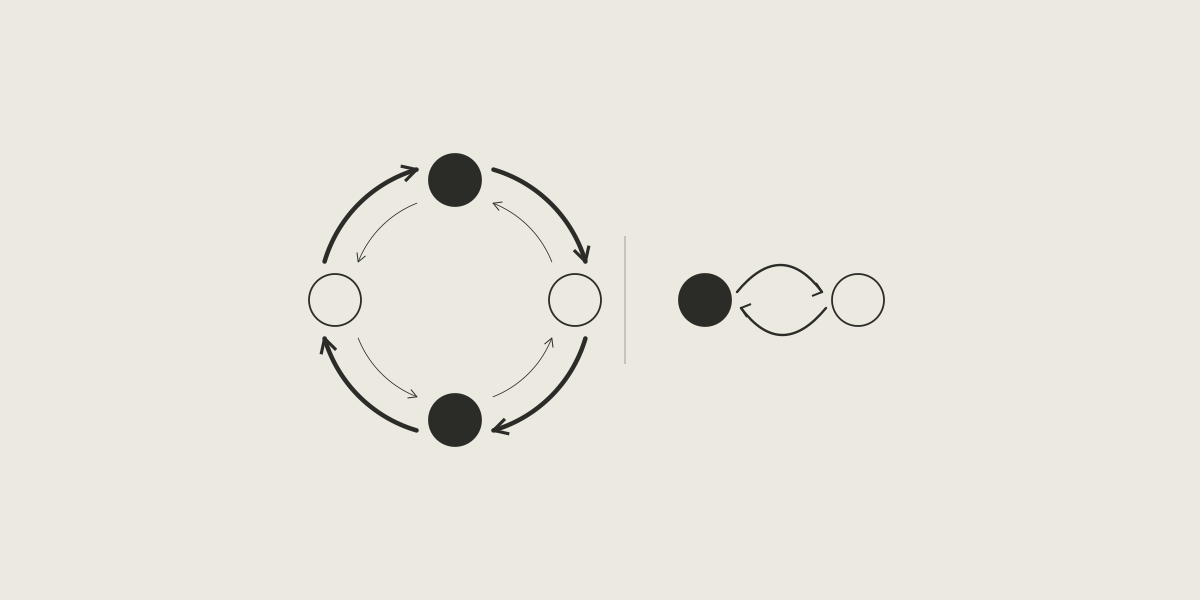
The witness in To Lay a Stone is a loop of four states, 0, 1, 2 and 3. At each step the system moves clockwise with probability 0.9 and anticlockwise with probability 0.1. Start it with every state equally likely, which is also the mix it keeps forever.
Played forward, a typical step goes clockwise, with probability 0.9. Played backward, the same step would be anticlockwise, with probability 0.1. Each step therefore contributes (0.9 − 0.1) × log(0.9/0.1), that is, 0.8 × log 9, about 1.76, with logarithms to base e. Over six steps the arrow is 6 × 0.8 × log 9, about 10.55. The forward and backward films are easy to tell apart.
Now watch the same loop through a cruder lens: record only whether the position is odd or even. Every step, in either direction, changes the parity, so what you see is odd, even, odd, even, or the same starting from even. "The observed process is deterministic alternation, which looks the same in both directions." The observed arrow is exactly 0. The image at the top shows the loop and what the parity lens leaves of it.
So a zero arrow at the coarse level says nothing about the fine level. In the paper's words, a zero observed arrow "cannot certify zero hidden irreversibility".
The rule: watching can only lower it
The opposite mistake cannot happen, as long as the watching is honest. Here honest means this: take the system's true history and relabel each moment by a fixed rule, such as odd or even, and compute with the exact probabilities of what results. For that kind of watching, "observing the path through a deterministic lens can only lower the value. Forgetting information cannot create an arrow of time."
The result behind this, the data-processing inequality, is a textbook fact of information theory, which the papers cite. Their contribution is to state it exactly for arrows of time and to mark its limits. It holds from any starting mix, and To Lay a Stone checks the general rule in Lean, a proof assistant. As stated there, it covers a fixed lens. No-Go Theorems for Audited Emergence, which comes up again below, extends it to an instrument that adds the same random noise independently at each moment: "Leaving the deterministic setting is therefore not by itself a way to create an arrow." It does not cover an observation that changes with time, whose arrow comes from "a clock in the observer", or a model built from the observations: those are different objects, and the rule says nothing about them.
The practical upshot is in the paper's list of working rules: "A positive observed arrow is a sound certificate; a zero observed arrow is inconclusive." If what you honestly observe has an arrow, so does the history beneath it.
That arrow need not come from anything pushing the system around, like the loop's built-in preference for clockwise. The paper gives a two-state system that, at each step, stays or switches with equal chances, a rule that plays the same forward and backward. Start it with 9/10 of the probability on the first state. After one step, the history "first, then second" has probability 9/10 × 1/2, while its reverse, "second, then first", has only 1/10 × 1/2. Forward and backward differ, and the arrow is (2/5) log 9, because the system is relaxing from a lopsided start. The paper calls this arrow real, and notes that it involves no drive at all.
Where invented arrows come from
If honest watching cannot invent an arrow, where do invented arrows come from? From replacing the honest record with something else. No-Go Theorems for Audited Emergence proves the rule and draws the same line: a chain fitted to the observed process falls outside the theorem, because "The fitted chain is a different object." The papers in the series document several such replacements.
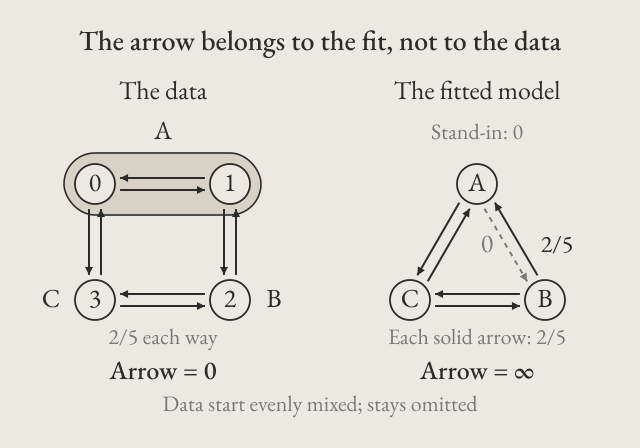
A model of the coarse states. To Chart a Stone takes a different loop of four states, one that runs equally well both ways: at each step it stays put with probability 1/5 and moves to each neighbor with probability 2/5. It groups states 0 and 1 together and keeps 2 and 3 apart, then builds a three-state model by picking the first state of each group as its stand-in and running the true dynamics one step from it. From the first group's stand-in, state 0, the system can never reach state 2 in one step. From state 2 it reaches the first group with probability 2/5. The model has a one-way street: a move that happens while its reverse never does. One sighting of it tells you which way the film runs, so the model's arrow is infinite. Started from its even, stationary mix, the real process has no arrow, and neither does its honest coarse view. "The arrow belongs to the fit, not to the data." The paper reports this for that choice of stand-ins; the point is that a model built for coarse states is not covered by the rule.
A rebuilt model. To Create a Stone rebuilds a coarse model by a different recipe, spreading each group's weight evenly over its states. For a six-state system that runs equally well both ways, the rebuilt model shows a tiny arrow, about 1.007 × 10⁻⁵ over ten steps, where the honest record has none. The rebuilt model is a new object, not the record of the true coarse history, and so the rule does not protect it.
The wrong stationary mix. The measure of sustained drive used in To Classify a Stone requires the system's stationary mix: the mix of states that stays the same from one step to the next. The paper shows what happens when that mix is computed carelessly. For a small three-state system with no drive at all, twenty steps of a common shortcut, plain power iteration, "give an apparent affinity of 0.23, but its true stationary law (1/8, 1/2, 3/8) gives zero." (Affinity, in that paper, is its measure of drive per step, and the stationary law is the stationary mix.) Fed a mix that is not stationary, the formula reports a drive the system does not have. The paper now insists that "Unconverged power iterates are never passed on as stationary laws", and its version history records that an earlier version of its own pipeline had used them.
A biased estimate. Estimating an arrow from data means counting how often each short stretch of history occurs and how often its reverse does. To Notch a Stone does this for a system with no arrow, where the true value is exactly 0, using ten runs of 80,000 steps each. The estimate is "0.002 at T = 1, 0.40 at T = 3, and 4.0 at T = 5", where T is the number of steps in each stretch. The reason is mundane: "many windows are seen once while their reversals are not, and the smoothed plug-in estimate cannot tell this sampling asymmetry from a real arrow." The paper rests its conclusions on exact values and on comparisons within one estimator, not on the size of these estimates.
None of these breaks the rule. Each replaces the honest record with a model, a rebuilt model, a wrong stationary mix or a finite sample.
Not every surprising arrow is fake
One case looks like an invented arrow and is not. Take several rules, each of which plays the same forward and backward, and apply them in a fixed order, over and over. The whole process can have a genuine arrow, because the order itself runs one way. To Lay a Stone is explicit: "This arrow is real: it is an actual property of the scheduled process, not an artifact of fitting." To Classify a Stone makes the same point about a model that hides the schedule: doing so "produces an effective kernel that is genuinely non-reversible." An earlier post on this site works through that case.
A claim that was replaced
The rule also corrected the series itself. An earlier version of To Notch a Stone had claimed that losing information in a lossy description generically produces an arrow of time. Its third version says: "The claim that lossy packaging generically produces an arrow is replaced by Propositions 1 and 2", the second of which is the rule above. The body now reads: "Losing history is not the same as creating an arrow: as we show in Proposition 2, a lossy map cannot turn a reversible process into an irreversible one."
What it does not say
The theorem is classical, and the papers do not claim otherwise; what they add are small exact cases and a clear line between honest observation and everything else. The arrow here is a measure of information. For a system in its stationary mix, and under extra physical assumptions, it becomes the entropy production of thermodynamics, but To Lay a Stone states that "Here it is used only as an information-theoretic audit, and no such assumption is made." The loop's numbers assume it starts in its even, stationary mix. Everything is finite: the paper's results "say nothing about continuum limits". And none of this explains where the cup's arrow comes from. It is a rule about measuring an arrow, not about the origin of one.
Within those limits the lesson is simple. An arrow seen through an honest lens is really there in the history, whether it comes from a drive or from a lopsided start. An arrow that vanishes through a lens may still be there. And an arrow that appears only in a model, a shortcut calculation or a small-sample estimate has to be checked against the honest record before it is believed.
Drawn from To Lay a Stone with Six Birds (Tsiokos, 2026, version 2, doi:10.5281/zenodo.23131875), with Six Birds: No-Go Theorems for Audited Emergence (version 2, doi:10.5281/zenodo.23343446), To Chart a Stone (version 2, doi:10.5281/zenodo.23120459), To Create a Stone (version 2, doi:10.5281/zenodo.23154591), To Classify a Stone (version 2, doi:10.5281/zenodo.23118249) and To Notch a Stone (version 3, doi:10.5281/zenodo.23120497), all by Tsiokos, 2026. The data-processing inequality is as cited in these papers (Cover and Thomas, Elements of Information Theory). The film analogy and the step-by-step arithmetic for the loop and the two-state system are mine, from the papers' formulas. No new result is claimed by this essay.