Papers · Preprint · v2
To Classify a Stone with Six Birds: Primitive Activation and Observable Separation of Layer-Birth Classes
Four kinds of layer birth, told apart by measurement.
In plain words
When a new layer appears, which primitives switched on? Packaging, directed circulation, or a staging anomaly.
That gives four classes of birth. All four are built and separated in a shared measured space of boundary location, affinity at the boundary and a staging proxy.
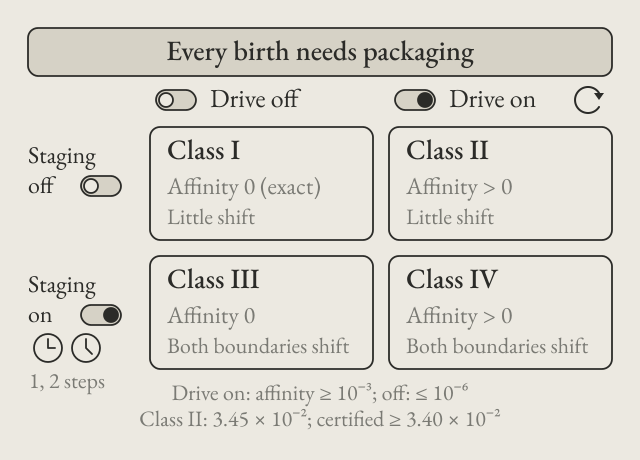
The clearest split is between births with a drive and without. Controls rule out fake arrows from coarse graining.
What it shows
- A taxonomy of four layer birth classes.
- Operational separation in one observable space.
- Capacity behaves as a post birth field, not a classifier.
What it does not claim
No universality exponents are claimed. The staging classes hold only for the hand chosen coarse-graining lens; under the two automatic lenses tried, they lose their staging label.
Cite
Tsiokos, I. (2026). To Classify a Stone with Six Birds: Primitive Activation and Observable Separation of Layer-Birth Classes. Zenodo. https://doi.org/10.5281/zenodo.23118249