Papers · Preprint · v2
To Flatten a Stone with Six Birds: Critical Pairs, Holonomy, and Confluence in Rewriting Systems
Confluence in rewriting is flatness in disguise.
In plain words
In a rewriting system, confluence means the order of steps does not matter in the end. In geometry, flatness means that locally the route does not matter. These sound alike, and the paper makes the analogy exact at the local level. The obvious carrier is wrong: small counterexamples show that flatness defined by cycles in the reduction graph neither implies nor follows from confluence.
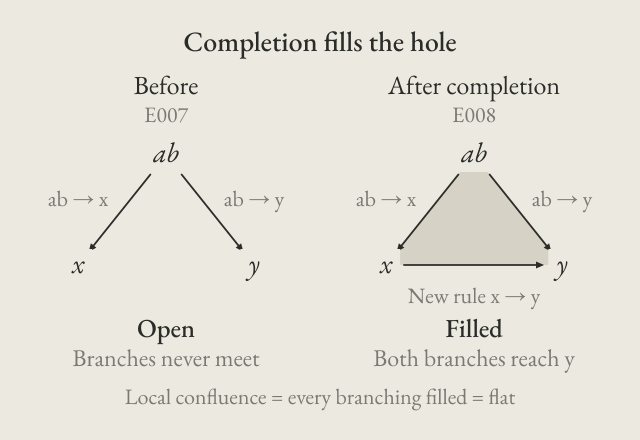
Instead, record each branching of two one step rewrites out of a common state. It has trivial holonomy when both branches can be completed to a common descendant, so its boundary closes up. With this definition, elementary flatness is exactly local confluence, for every abstract rewriting system, checked in Lean 4. Under termination, Newman's lemma makes confluence, elementary flatness and unique normal forms coincide.
An exhaustive enumeration of all 66,066 rewriting relations on one to four states agrees with the theorems and finds the smallest counterexamples showing each hypothesis is needed. In string and term rewriting, the branchings that can fail are the overlaps recorded by critical pairs. Completion reads as holonomy elimination: the added rule leaves the branching in place but supplies the missing filler.
What it shows
- Local confluence equals elementary flatness for every abstract rewriting system.
- Cycle based flatness fails as a test; reachable critical pair defects track the obstruction.
- Completion read as removing holonomy.
What it does not claim
No new confluence criterion for term rewriting is claimed, and no holonomy theory in the sense of a group valued connection. The term rewriting examples are curated left linear systems, each explored completely from a start term.
Cite
Tsiokos, I. (2026). To Flatten a Stone with Six Birds: Critical Pairs, Holonomy, and Confluence in Rewriting Systems. Zenodo. https://doi.org/10.5281/zenodo.23088991