Papers · Preprint · v2
Six Birds: No-Go Theorems for Audited Emergence
Eight things an emergence story cannot honestly claim in a finite model.
In plain words
Take a finite system watched through a lens. Define its arrow of time as the gap between the law of a path and the law of the same path reversed.
Watching through a lens cannot increase the arrow. So a chain started in a law that satisfies detailed balance shows zero arrow through any lens, however rich the hidden protocol structure it carries.
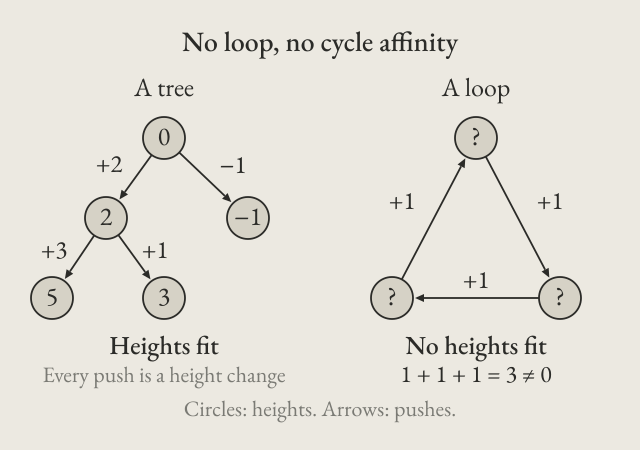
Other theorems: on a forest every antisymmetric edge field is the gradient of a potential, so a nonzero cycle affinity needs both a cycle and a field that is not a gradient. The best macro kernel has an exact closure deficit, which depends on the current law. Under contraction, a stable law is close to the one stationary law. And a ladder of levels saturates inside a fixed interface or under idempotent packaging. All eight theorems are now formalized in Lean.
What it shows
- A data processing inequality for the arrow audit.
- Graph obstructions for antisymmetric edge fields.
- An exact closure deficit for the best macro kernel.
- Contraction bounds for objects, and saturation inside a fixed interface.
What it does not claim
State spaces are finite, except in the graph and ladder theorems, time is discrete, and lenses are deterministic, though the arrow bound extends to memoryless noisy observation. An observation that depends on time can show an arrow, but that arrow comes from a clock in the observer. The theorems concern exact observation, not fitted chains, thresholded graphs or finite samples. Each says what an emergence claim must add; none says emergence is impossible.
Cite
Tsiokos, I. (2026). Six Birds: No-Go Theorems for Audited Emergence. Zenodo. https://doi.org/10.5281/zenodo.23343446