Papers · Preprint · v2
To Chart a Stone with Six Birds: Emergence Phase Diagrams for Effective Theories in Control Space
Emergence as a phase diagram.
In plain words
Sciences draw maps of where behaviors are possible: phase diagrams, stability charts, feasibility regions. Emergence is rarely treated that way.
This paper draws emergence atlases: maps over control space showing where a macro description is feasible. Feasible means closed, nontrivial, safe under audit and within budget.
Atlases are computed for law families, for all packagings of small systems, and for the PICA algebra. Rival definitions of emergence become slices of one atlas.
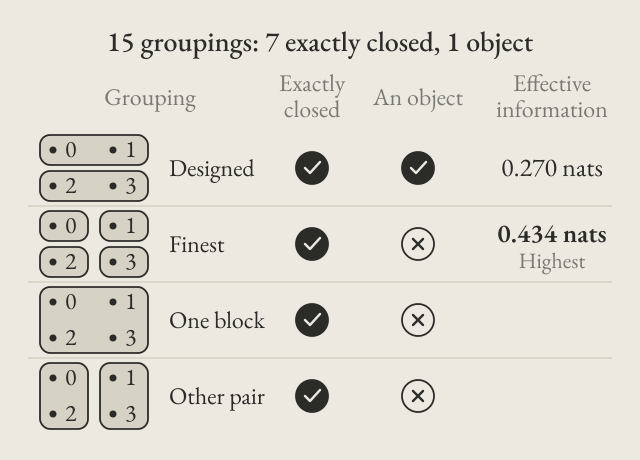
What it shows
- Exact closure loci and reversible lines recovered.
- Tradeoffs among closure, directionality, information and budget exposed.
- A negative result in mechanism space: the earlier geometry regime and its ablation ranking are withdrawn, and a compact mechanism fails a test fixed in advance.
What it does not claim
Finite state setting only.
Cite
Tsiokos, I. (2026). To Chart a Stone with Six Birds: Emergence Phase Diagrams for Effective Theories in Control Space. Zenodo. https://doi.org/10.5281/zenodo.23120459