Papers · Preprint · v2
To Spend a Stone with Six Birds: Currency-Constraint Duality and Shadow Prices Across Closure Layers
Why temperatures, prices and attention weights are the same kind of thing.
In plain words
Temperatures, prices, regularization strengths and attention weights each put a single number on a limited resource. The paper defines such a currency by the job it does relative to a layer: bounding what is feasible, adding up along protocols, driving a monotone potential, or pricing a constraint.
The principle is conditional. If keeping a higher-level object requires holding a lower-level ledger within a budget, that ledger becomes a constraint for the higher layer. If the higher layer then closes by maximizing entropy under the budget, the multiplier of that constraint is a nonnegative shadow price. The paper proves this finite duality, including exactly when the price is positive, zero or infinite.
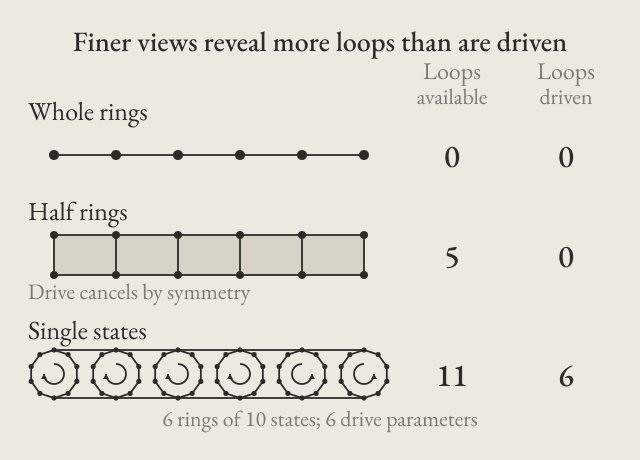
A finite Markov laboratory illustrates each step. The fitted price follows the predicted curve and vanishes once the budget is slack. A resolution ladder exposes more cycle directions (0, 5, 11) than are actually driven (0, 0, 6). A cost derived from the ledger predicts held-out transitions better than a scale-matched proxy. Lean 4 checks the single-row duality and the fact that coarse observation cannot create path-reversal asymmetry.
What it shows
- A layer relative definition of currency.
- The currency constraint principle as a proved conditional duality.
- Finite laboratory checks of each step, and a Lean 4 formalization of the duality and the data-processing inequality.
What it does not claim
Persistence alone does not create a budget: the principle applies once a resource law is given. No claim about any specific economy or physical system.
Cite
Tsiokos, I. (2026). To Spend a Stone with Six Birds: Currency-Constraint Duality and Shadow Prices Across Closure Layers. Zenodo. https://doi.org/10.5281/zenodo.23088986