Papers · Preprint · v2
To Cast a Stone with Six Birds: A Closure-Deficit Account of Randomness under Packaging and Budget
Randomness as the price of zooming out.
In plain words
Randomness is usually either in the world or in our ignorance. This paper develops a third answer: much of what a description calls randomness is information the description chose not to keep. Pick a way to package the micro state into a macro state. The closure deficit is the information about the next macro state that is still hidden inside the current micro state.
This gives an exact split of macro uncertainty into two parts: what would remain even with the full micro state, and what the packaging adds.
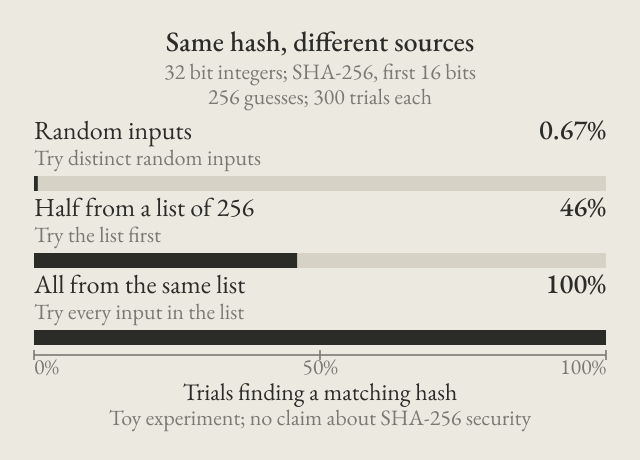
The deficit vanishes for lumpable partitions, and when every state has positive stationary probability only for them. Across seventeen benchmark conditions it grows with heterogeneity inside packages and tracks route mismatch closely. Memory of past packages buys back surprisingly little: a window of eight recovers about 0.008 of 0.110 nats. In a toy hashing experiment, inputs drawn uniformly are as hard to invert as for an ideal random function, while inputs from a small dictionary are easy. A deterministic map can hide only the distinctions its inputs supply.
What it shows
- An exact decomposition of macro entropy.
- A bound on route mismatch through Pinsker's inequality, and a correlation of 0.96 with it across benchmarks.
- A cap on what any amount of packaged memory can recover, for Markov substrates.
- Hash inversion difficulty set by where the inputs come from.
What it does not claim
Randomness is not treated as primitive, and no claim is made about quantum randomness.
Cite
Tsiokos, I. (2026). To Cast a Stone with Six Birds: A Closure-Deficit Account of Randomness under Packaging and Budget. Zenodo. https://doi.org/10.5281/zenodo.23120474