Posts · Mathematics
Collatz Keeps Exact Books
Every Collatz orbit satisfies an exact identity in whole numbers, and falling below the start becomes an inequality between integers. Yet at every depth, two numbers that agree in their last binary digits disagree about what happens next.
Pick a positive whole number. If it is even, halve it. If it is odd, triple it and add one. Repeat. Start from 7 and you get 22, 11, 34, 17, 52, 26, 13, 40, 20, 10, 5, 16, 8, 4, 2, 1. The sequence a starting number produces is called its orbit. The Collatz conjecture says that the orbit of every positive starting number eventually reaches 1. It is still unproved.
A paper in the Six Birds series behind this site, A Catalog of Dynamical Structural Laws, uses the problem as an example. It does not try to settle the conjecture. It puts two facts side by side: the orbit keeps exact accounts, and yet the next line of the accounts cannot be read off from the number's last few binary digits.
The accelerated map
The paper works with a faster version of the rule. Starting from an odd number n, triple it, add one, and then halve as many times as possible in one go. The number of halvings is written a(n), and the result is the next odd number in the orbit. From 7: 3 × 7 + 1 = 22, one halving, 11. Then 34, one halving, 17. Then 52, two halvings, 13. Then 40, three halvings, 5. Then 16, four halvings, 1. Only the odd numbers of the original sequence remain, and the halving counts 1, 1, 2, 3, 4 record how each step went.
The ledger
"At the same time the bookkeeping of an orbit is exact." Think of the halving counts as the entries of a ledger. After k steps, let Ak be the total of the entries so far. Then the current value nk satisfies
2Ak × nk = 3k × n + Bk
where n is the start and Bk is a whole number built from the entries: B starts at 0, and each step triples it and adds 2 raised to the total of the entries before that step.
For the orbit of 7, B runs 1, 5, 19, 73 over the first four steps. After four steps the value is 5 and the entries total 1 + 1 + 2 + 3 = 7. The ledger says 27 × 5 = 34 × 7 + 73, and indeed both sides are 640. (That arithmetic is mine; it is the paper's identity applied to one orbit.)
The identity is old. "The ledger is standard in the Collatz literature," the paper says, citing Lagarias's 1985 survey. What it does is turn the central question into an inequality between whole numbers. The orbit has fallen below its start at step k exactly when 2Ak × n is greater than 3k × n + Bk. For 7 at step four, 27 × 7 = 896, which beats 640, so the orbit has dropped below 7.
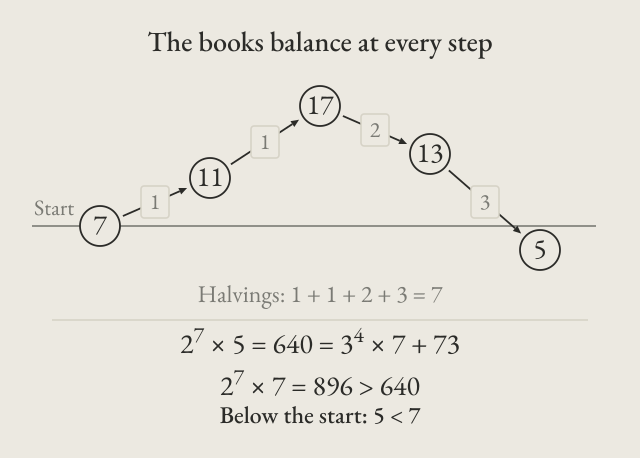
Falling below the start is enough. If every starting number other than 1 eventually falls below itself, then the orbit of any number keeps reaching smaller and smaller values, which cannot go on forever among positive whole numbers, so it ends at 1. Hence the paper's remark about its inequality, with the loop at 1 set aside: "Whether every orbit eventually satisfies it is the Collatz conjecture, which this paper does not settle."
The ledger also constrains cycles. If an orbit came back to its start after k steps, the identity would give (2Ak − 3k) × n = Bk. So a cycle of positive whole numbers can occur only for sequences of entries that make Bk divided by 2Ak − 3k a positive whole number. This does not rule cycles out by itself; it turns each candidate sequence of entries into a fraction to test. The familiar loop at 1, where 3 × 1 + 1 = 4 takes two halvings back to 1, passes the test, as it must.
What the last digits cannot tell you
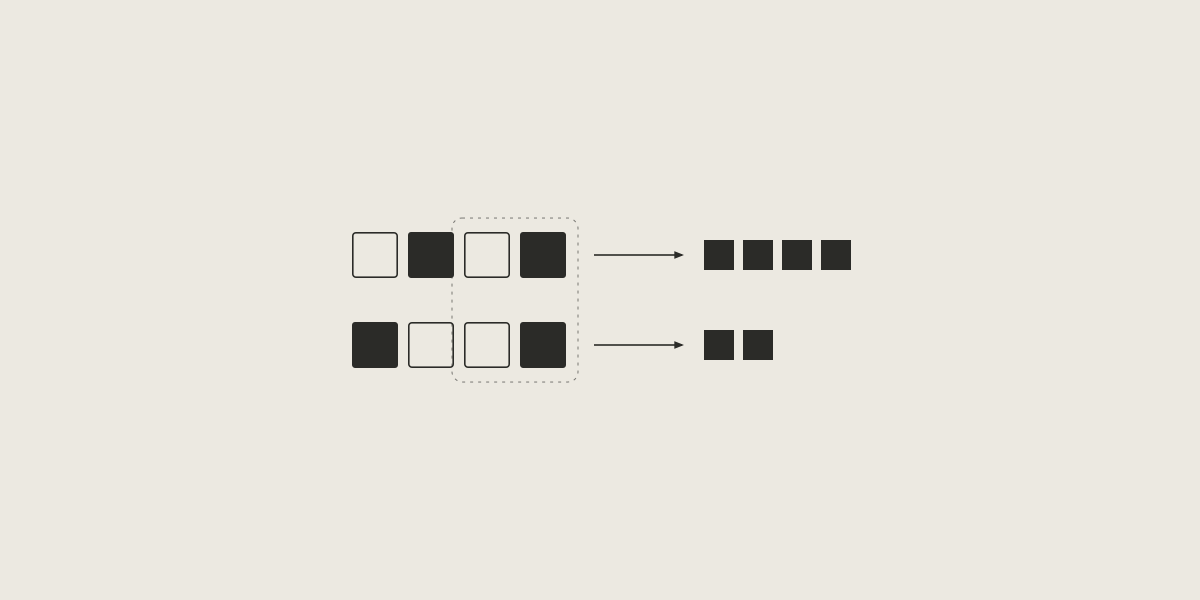
Against that exactness stands a second fact. Take 5 and 9. In binary they are 101 and 1001, so they agree in their last two digits; equivalently, both leave remainder 1 when divided by 4. But 3 × 5 + 1 = 16, so a(5) = 4, while 3 × 9 + 1 = 28 = 4 × 7, so a(9) = 2. "Knowing n modulo 4 does not determine even the first division exponent", where the division exponent is the paper's name for the number of halvings.
The paper proves that this happens at every depth, though it does not claim the observation as new. For each m it gives two odd numbers that agree in their last m binary digits and yet need exactly m halvings and at least m + 1 halvings at their next step. The recipe is short: the first number is (2m+1 × c − 1)/3, with c equal to 1 or 2, whichever makes this a whole number, and the second is the first plus 2m. For one digit this gives 1 and 3, for two digits 5 and 9, and for three digits 5 and 13, which share their last three binary digits, 101, and need four halvings and three. So no rule that reads a fixed number of trailing digits can predict the next entry of the ledger. In the paper's general vocabulary, such a pair is a split pair: two states that look the same to an observer at some depth and have different futures. "If a split pair exists at every depth, no observer who looks at a fixed number of digits can predict the readout."
The digits are not useless. Whether 3n + 1 is divisible by 2m depends only on the last m digits of n, so whenever the next entry is less than m, the last m digits already show it. What they cannot do is put a ceiling on it. (That observation is mine, from the definition.)
A ghost at −1
The paper notes one more way the digits mislead. Apply the same rule to −1: 3 × (−1) + 1 = −2, one halving, and you are back at −1. It is a fixed point, a number the rule leaves where it is. It lies outside the positive numbers the conjecture is about, and the paper places it in the 2-adic integers, a number system that extends the integers. "It is not an integer orbit, but integer orbits can imitate it for a long time."
The imitators are the numbers one less than a power of two, such as 15 = 24 − 1. Since 2L − 1 and −1 differ by exactly 2L, an observer who sees only the last L binary digits cannot tell them apart. And at first the orbit behaves like −1, one halving per step: 15, 23, 35, 53, before 3 × 53 + 1 = 160 finally takes five halvings and drops to 5. In general, 2L − 1 takes one halving at each of its first L − 1 steps and stays above its start at least that long. So no bound on the time to first fall below the start can hold for every number.
The paper builds this into a conditional argument with two hypotheses, stated in terms of a shrinking family of regions around the ghost points, of which −1 is one: first, that any orbit which never falls below its start eventually enters, and stays inside, each of those regions; second, that every orbit starting above 1 eventually stays outside at least one of them. If both held, every starting number other than 1 would eventually fall below its start. Both are unproved for the Collatz map, and the paper insists that the second, the separation of real orbits from the ghost, "must be established by arguments about the integers alone."
What it does not say
The paper is plain about its limits. The split pairs, it says, "rule out fixed-depth prediction; they are not evidence about liveness", where liveness means that every orbit, apart from the loop at 1, eventually falls below its start. It imports classical results with attribution and labels nothing as new. The ledger and the halving counts of the split pairs, at every depth, are checked in Lean, a proof assistant; the remarks about the ghost, the numbers 2L − 1 and the cycle condition are argued on paper.
Within the catalog, Collatz illustrates a pattern the paper calls hidden amortized solvency. "A point is solvent once it has earned a certificate of descent", a checkable proof that it fell below its start, and the debt it carries until then is paid off over many steps. The paper's reading of the problem follows from the two facts: "The two facts show where the difficulty lives: in an exact ledger whose next entry is not predicted by any fixed number of low-order digits." The books balance exactly at every step. The trouble is that the next entry can be any size, and no fixed amount of looking at a number's last digits says how large.
Drawn from Six Birds Foundations VI: A Catalog of Dynamical Structural Laws (Tsiokos, 2026, version 2, doi:10.5281/zenodo.23187548), Sections 1.1 and 6.1. The ledger is standard (J. C. Lagarias, "The 3x+1 problem and its generalizations", American Mathematical Monthly, 1985, as cited there). The orbits of 7 and 15, the B values, the depth-three pair, the check of the loop at 1, the step from falling below the start to reaching 1, and the remark about digits below m are my own arithmetic from the paper's definitions. No new result is claimed by this essay.