Papers · Foundations · v2
Six Birds Foundations VI: A Catalog of Dynamical Structural Laws
Thirteen candidate laws about what happens over time, not just in a snapshot.
In plain words
The earlier Six Birds papers prove facts about states. Each law takes one map or one package and says something fixed about it. Nothing in them says what happens when a system runs for a long time.
This paper fills that gap. Does every path eventually earn its certificate? What does it cost over an unbounded run? What happens when the obstacle grows, reacts, or is made by the system's own history? Thirteen candidate laws answer questions like these, each with a quantifier over time or scale that no static law has. Seven are laws with a concrete system in which the hard hypothesis is proved, two are general theorems with classical instances, and four are templates whose hard hypothesis remains open.
The laws were mined from odd math puzzles: Collatz, Goodstein, Egyptian fractions, sandpiles, the angel problem, aperiodic tilings and more. Each puzzle's folk proof points at an object. What is left after comparing that object with every existing law becomes the seed of a new one.
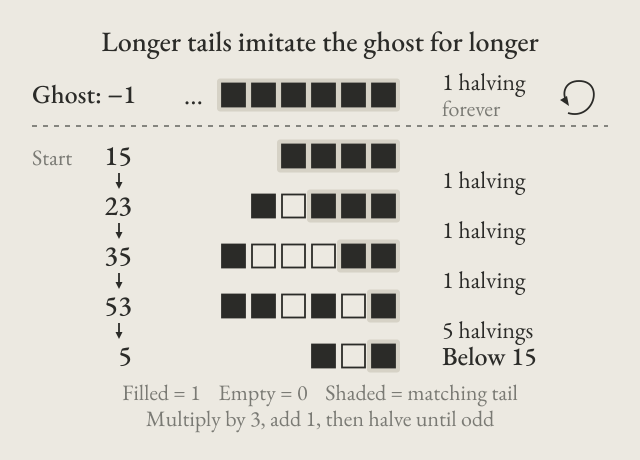
What it shows
- Thirteen candidate dynamical laws: seven proved laws, two general theorems and four templates with an open hypothesis.
- Classical results are imported with attribution, and nothing is labelled new.
- Famous puzzles are used as detectors for laws, not as targets.
What it does not claim
It does not solve Collatz or any of the puzzles it draws on.
Cite
Tsiokos, I. (2026). Six Birds Foundations VI: A Catalog of Dynamical Structural Laws. Zenodo. https://doi.org/10.5281/zenodo.23187548