Posts · Foundations
Close Enough Is Not the Same
A reads like B, and B reads like C, but A does not read like C. No single reading of each thing produces that pattern, and forcing it into one merges far more than was close. Two papers say what to do instead.
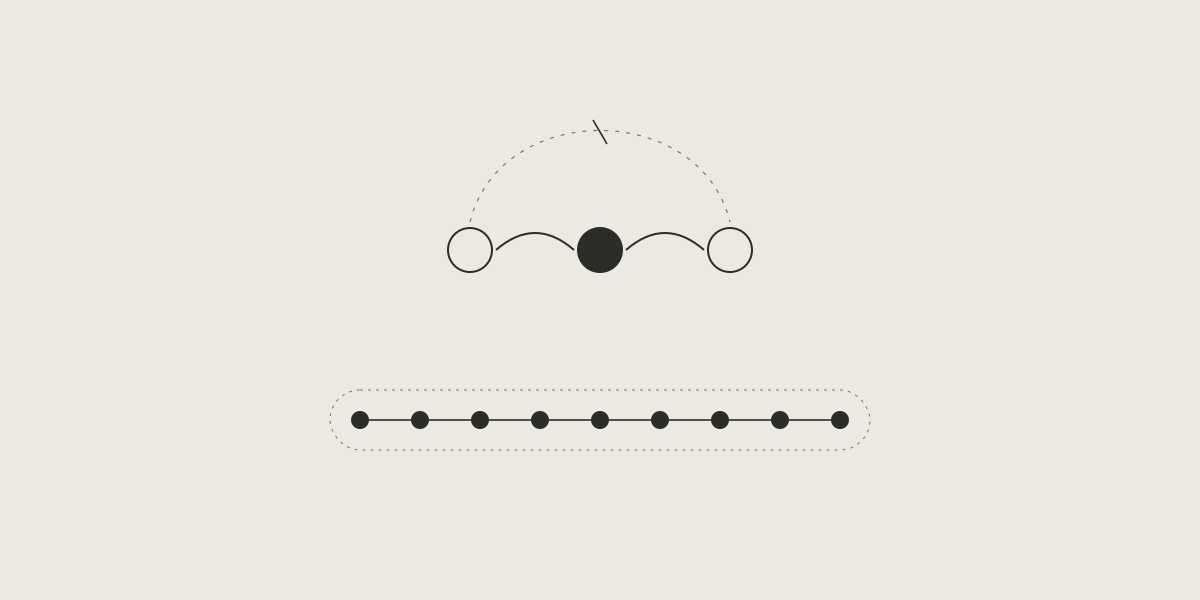
Suppose a thermometer reads to the nearest half degree, and you call two samples alike when their readings differ by at most half a degree. Sample A reads 20.0, B reads 20.5 and C reads 21.0. Then A is alike to B, and B to C, but A is not alike to C. The old paradox of the heap has the same shape: adding one grain never seems to make a difference, yet enough grains do.
Two papers in the Six Birds series, the body of work behind this site on how coarse descriptions of a system arise, take this shape apart: A Typed Calculus of Coarse-Graining and Tolerance and Surrogates. Coarse-graining means describing something with less detail, as a thermometer does. The second paper starts from the practical version of the problem: a thermometer of finite resolution, or a clustering of measured data, gives values that are close but not equal.
Closeness is not a reading
A relation like "within half a degree" has two of the three properties of sameness. Everything is close to itself, and if A is close to B then B is close to A. What it lacks is the third: closeness does not carry over from A to B to C. Mathematicians call such a relation a tolerance, an idea that goes back to Zeeman in 1962 and Sossinsky in 1986, as the papers note.
Compare a different rule: give each thing a single label and call two things the same when their labels match exactly. The first paper calls such a labeling a lens. Matching labels always carry over: if A's label matches B's and B's matches C's, then A's matches C's. And the converse holds too: a tolerance that does carry over sorts things into classes, and the class can serve as the label. So a tolerance comes from some lens exactly when it carries over, a classical fact the paper proves in three sentences. "A nontransitive tolerance is expressed by no lens."
The thermometer does give each sample one reading, but "alike" is not "same reading"; it compares two readings against a threshold. That is the point: closeness is a fact about pairs, and no way of labeling the things one at a time will turn it into a label.
Forcing it to be sameness
One tempting fix is to declare close things the same anyway, and then, to keep sameness consistent, also declare the same anything that can be reached by a chain of close steps. The smallest consistent version of sameness that contains the closeness relation does exactly that: two things end up the same when a chain of close steps joins them.
If every thing is joined to every other by some chain, everything becomes one lump. A row of points, each close only to its neighbors, ends up as a single class. The second paper puts it in one sentence: "Declaring a tolerance an equivalence merges far more than was close." In a row of ten points only nine pairs were close, but all forty-five pairs end up the same. A relation that falls into several separate chains collapses into those chains instead.
This is the heap in miniature. Each step from one pile to the next is close, and declaring closeness to be sameness makes every pile in the chain the same.
Reporting one value per class
The second paper asks a more useful question. Suppose things are already sorted into classes, and each class must report a single value that stands for all its members. Picture samples grouped by the vat they came from: each sample has its own measured temperature, and each vat must report one temperature, chosen from a list of allowed values such as the marks on the scale. (The vats are my illustration.) The reported value must be close to the measured temperature of every sample in the vat. The paper calls such a value a common center.
The right test is the common center itself, not closeness among the members. The paper's example is three points 0, 1 and 2 on a line, close when at most one apart, and a class whose members read 0 and 2. In the thermometer's terms: one vat with samples at 20.0 and 21.0. The two readings are not close to each other. Yet 1, or 20.5, is close to both. A single reported value works, even though the members are not pairwise close. The image at the top shows this case.
The paper then marks how far pairwise closeness can be trusted. If one of the class's own readings is on the allowed list, pairwise closeness is enough, because that reading serves as a common center. In the other direction, if a common center exists, every two readings are within two steps of each other, through the center.
But being within two steps is not enough in return. On a loop of four points, each close only to its two neighbors, take a class whose members read all four. Every pair is within two steps, yet any candidate center misses the point opposite it. When every point may serve as a center, this is as small as such a failure can be: four points. And three points is the smallest case where a center exists without pairwise closeness.
How good the best report can be
With distances, the paper scores a center by its largest distance to any reading in the class, and the best center's score is called the radius. Compare it with the diameter, the largest distance between two readings in the class.
Two bounds hold, each under a condition. If distances obey the triangle inequality, which says that going directly is never longer than a detour, the radius is at least half the diameter. If the allowed list contains one of the class's own readings, the radius is at most the diameter. Both ends occur on the same readings. On the line with readings 0 and 2, the diameter is 2. If every point is allowed, the midpoint 1 gives radius 1, half the diameter. If only 0 and 2 are allowed, the radius is 2, the whole diameter.
Each condition matters. With distances of 1 from 0 to 1 and from 1 to 2, but 3 from 0 to 2, which breaks the triangle inequality, the center 1 has radius 1 while the diameter is 3. And a class with the single reading 0, allowed to report only 2, has diameter 0 and radius 2.
No single best repair
When no common center exists, and every class has at least one allowed value, one can enlarge the closeness relation until one does. The paper compares three ways. Enlarging it until the members of each class are pairwise close, or further until it becomes a full sameness relation, each has a single smallest version. The third way, enlarging it just enough that some allowed center serves each class, need not.
Three points suffice to show it. Start from strict equality on 0, 1 and 2, so that nothing is close to anything else, with a class whose members read 0 and 1, and every point allowed as a center. Using 0 or 1 as the center requires adding one close pair, 0 with 1. Using 2 requires adding two, 0 with 2 and 1 with 2. Each repair is minimal in the sense that removing any pair it added breaks it, and neither contains the other. What they have in common, plain equality, admits no center. "So there is no least center repair, and 'the minimal repair' is not well defined". Counting added pairs would pick the first, but that is a choice, and it quietly throws away a second repair that is just as minimal.
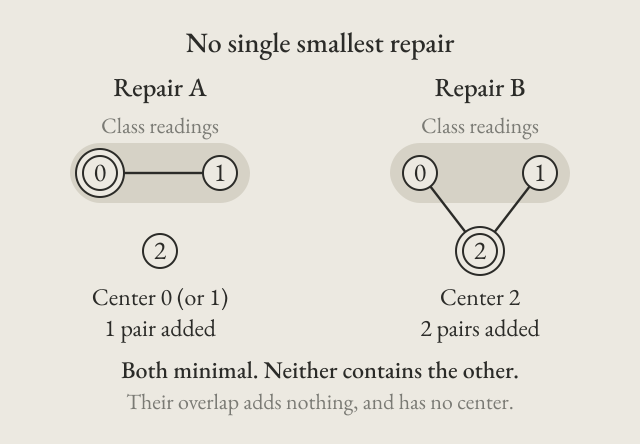
What the paper offers instead is the whole family of minimal repairs, computed by a finite construction. It also notes that different ways of ranking them, such as fewest added pairs or smallest radius, can pick different ones.
What it does not say
The things being sorted and the lists of allowed values are finite, the calculations are exact, and the papers say which parts are classical. The idea of a tolerance is Zeeman's and Sossinsky's. Finding the best common center is the classical one-center problem, placing a single point to minimize the largest distance, credited to Hakimi (1964) and Megiddo (1983); the second paper says its contribution lies in the framing and the repairs, "not the minimax itself." It also notes that its basic common-center criterion "restates what an approximate factor is", the paper's term for a valid report; the content lies in the conditions and the sharp examples. Most of the general theorems are checked in Lean, a proof assistant, with a few parts left to the paper's own proofs, and some of the small examples, including the three-point repair, are checked by having Lean compute them.
The lesson is about bookkeeping. Close is not the same. Treating it as the same either fails, because no single labeling produces closeness, or overshoots, because chains of close steps merge everything they connect. A class can still report one honest value, a common center, and the paper states exactly when the simple tests for one work and gives the smallest examples where they fail.
Drawn from Six Birds Verified IV: Tolerance and Surrogates (Tsiokos, 2026, doi:10.5281/zenodo.23097917), Part I, and Six Birds Foundations VIII: A Typed Calculus of Coarse-Graining (Tsiokos, 2026, doi:10.5281/zenodo.23097905), Section 14. Zeeman (1962), Sossinsky (1986), Hakimi (1964) and Megiddo (1983) are as cited there. The thermometer readings, the vats, the heap and the ten-point count are mine. No new result is claimed by this essay.