Posts · Physics
Three Things We Call Time
Order, ticks and an arrow are usually bundled together as time. A small simulated laboratory pulls them apart, including a clock that looks stable only because it has stopped advancing.
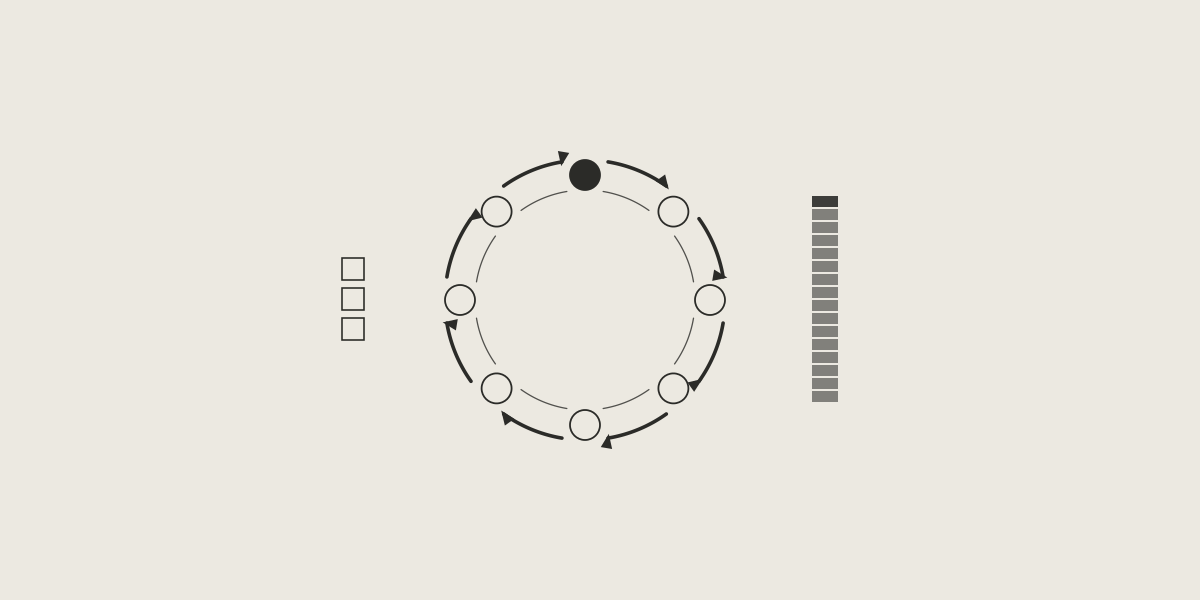
When we say a system has time, we usually mean several things at once. Its states come in a sequence, one after another. Something in it can count, like a clock. And it has a direction, so that its history run backward looks wrong. To Notch a Stone calls these order, ticks and an arrow, and shows in a small model that they can come apart. A process can have order but no arrow, an arrow but no usable clock, and even "a clock that looks stable only because it has stopped moving."
The laboratory
The model is a computer simulation, small enough to be analyzed exactly. Its state has three parts: an environment with three settings, a phase with eight positions arranged in a ring, which acts as the hand of a clock, and a ledger with sixteen levels, a bounded record of progress. The image at the top shows them.
At each step, mostly at random, the environment may update or the phase may move. A drive makes the phase more likely to step forward than back: with the drive used here, a regular phase move goes forward four times in five. Occasionally noise throws the phase to a random position. When the phase steps forward, the ledger may record it by going up one level, and the ledger can also slip back down. In the results below the environment is not linked to the phase and plays no special role.
A tick is an entry into phase 0, the top of the ring. Drift is any change of the phase other than a forward step. The arrow is measured as in the earlier post on hidden arrows: by comparing how likely each history is with how likely the same history is played backward. The paper uses the rate at which those two sets of probabilities pull apart, known in physics as entropy production, purely as a measure of information, without claiming anything about heat or energy.
An arrow without a growing counter
One might expect the arrow to show up as some quantity that keeps going up. The paper proves that, for a model like this one, with finitely many states and random steps that depend only on the current state, once it has settled into its long-run behavior no quantity read off its current state can do that. Such a quantity has an average change of zero per step. And if it never goes down along any allowed step, then, since it averages zero change, it never changes at all among states the system can travel between. "So a stationary arrow cannot be read off as steady growth of a bounded state variable; it must be read from path statistics", meaning from the probabilities of whole histories. The zero average needs a system that has already settled; the second part, about a quantity that never goes down, holds even before that.
The ledger illustrates it. Once the driven system has settled, the ledger sits almost always at or next to its top level and occasionally slips back, so it does not keep accumulating. The arrow is there anyway, and in fact the measure is infinite. Some moves have no reverse at all. A forward step that comes with a slip of the ledger is one: running it backward would need a backward step that raises the ledger, and the ledger only rises on forward steps. A single sighting of such a move tells you which way the film is running, and that makes the two sets of probabilities infinitely far apart.
A count that depends on the whole history, such as the number of records ever written, can grow without bound. The paper's point is that this is a different kind of object: a fact about the path, not about the present state.
Pulling the three apart
The separations come from comparing settings of the model and from constraints that forbid certain moves.
Order without an arrow. With no drive and no ledger, the model is reversible: its history played backward is exactly as likely as forward, and the arrow measure is zero.
An arrow without a usable clock. With the drive on but extra noise, the hand slips often. In 92 percent of the stretches from one tick to the next, the phase drifts at least once.
An arrow without ticks. Forbid every move into phase 0. The hand still moves, about 303 forward steps per thousand, wandering over the other seven positions, and the arrow measure stays infinite. But the hand can never pass through the top of the ring, so no tick ever happens. The paper is careful about what that means. The level of description it is auditing "has not become a perfect clock; it has lost the ability to count time in ticks." The failure rate of its ticks is undefined, not zero.
A clock that looks good because it stopped. In the driven setting without extra noise, the hand drifts about 162 times per thousand steps. Now forbid every step from one position to its neighbor, so that only noise can move the hand. Drift falls to 67.5 per thousand. Judged by drift alone, this is the better clock. But the hand never steps forward, its few ticks, about 8 per thousand steps, come from noise happening to land on phase 0, and every stretch between ticks contains drift. Forbidding the steps also removed the drive, so there is no arrow either. "A clock can look stable simply because it has stopped advancing." Stability, the paper concludes, has to be checked together with progress.
Reliability can be bought, for a while
Can the noisy clock be fixed? The paper gives it an outside repair budget: whenever the phase is about to drift, a repair turns the drift into a forward step instead, as long as repairs remain. It ran three budgets over 60,000 steps: none, 3,000 repairs and 12,000.
Without repairs, 92 percent of the stretches between ticks contain drift. With 3,000 repairs, the budget runs out early and the figure falls only to 76 percent. With 12,000, the budget lasts almost the whole run, and the figure falls to 1.8 percent. The ticks themselves do not change: about 86 per thousand steps throughout, so "the repairs make the existing ticks reliable rather than faster."
Two cautions keep this honest. First, while the budget lasts every drift is repaired, so the results mostly measure how long the budget lasts: each one is almost exactly the share of drift left unrepaired times the failure rate with no repairs (a check I made from the paper's table). Second, the repairs come from outside the model, and the paper proves nothing about their cost: "the repairs are an intervention from outside the chain; and we prove no lower bound on the cost of any clock." In a process that stays noisy forever, any finite budget runs out.
No single time
The last result concerns translating between clocks. Take three ways of reading the phase. Reading A reports the exact position. Readings B and C only know which pair of neighboring positions the hand is in, {0, 1}, {2, 3}, {4, 5} or {6, 7}, and report a standard member of the pair: B the even one, C the odd one.
Now translate a reading around the loop A, B, C and back to A, and add up how far each step moves the reported time. Start with the hand at 2. A reads 2. B, knowing only the pair {2, 3}, reports 2: no change. C reports 3: up by one. A, handed C's version, reads 3: no change. The loop comes back one step ahead. Start at 3 instead: A reads 3, B reports 2, down one, C reports 3, up one, A reads 3. The loop comes back even. Averaged over positions, the loop gains half a step.
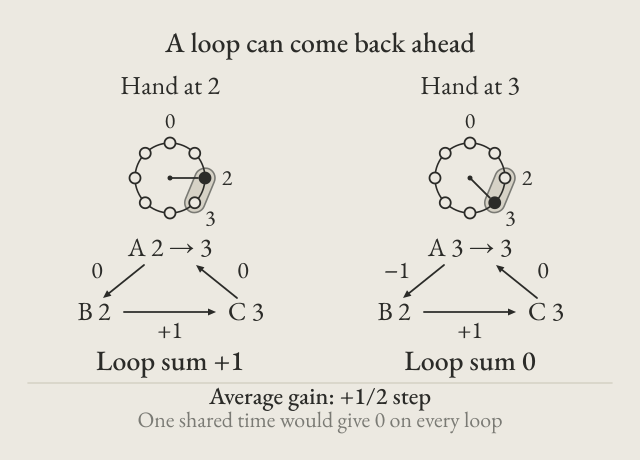
A single shared time would mean giving each reading one clock value so that every translation is just the difference between two of them. Then any trip around a loop would add up to zero. The paper's theorem, checked in Lean, a proof assistant, says exactly this: if the offsets around a loop add up to anything other than zero, no single time coordinate reproduces all the translations. The proof is one line; the laboratory supplies a case where the sum is not zero. A control in which all three readings use the same member of each pair gives zero.
Two cautions. The theorem runs one way: restricted to odd positions, the loop above sums to zero, yet the readings still do not fit together. And "global time" here means only a coordinate that reconciles these particular readings. The paper says plainly that this is "not a statement about global time functions or foliations in relativistic spacetime."
What it does not say
The paper's first stated limit is "A laboratory, not spacetime." The model "does not model physical spacetime, continuous dynamics, or quantum fields". The clock results hold for particular settings and budgets: "They illustrate mechanisms; they are not general theorems." The theorem about loops is checked in Lean; the result about settled systems is proved on paper; and the experiments are simulations run with fixed random-number settings, so they can be repeated.
Within that model, the word time covers at least three separate requirements. A system can meet one and fail another, and a clock that looks steady is worth checking for whether it is still moving.
Drawn from To Notch a Stone with Six Birds: Time as a Theory Artifact of Order, Measure, and Arrow (Tsiokos, 2026, version 3, doi:10.5281/zenodo.23120497). The numbers, the loop offsets, the quotations and the reason a forward step with a ledger slip has no reverse are from the paper. The comparison of the repair results with the share of drift left unrepaired is my arithmetic from its Table 4. No new result is claimed by this essay.