Posts · Physics
The Arrow Belongs to the Clock
Two time-symmetric steps can make an arrow of time when run in a fixed order. The arrow is real, but it belongs to whatever keeps the order, not to the steps.
Here is a small puzzle. Take a system that hops at random between a few states, and two different rules for hopping, each perfectly balanced in time. Watch either rule at work for as long as you like, and a film of it run backwards is exactly as likely as the film run forwards. Now alternate the two rules, first one and then the other, over and over. For the right pair of rules, the alternation has a direction: the system tends to circle one way, and a long recording of it can be told apart from the same recording played backwards.
That last property is what "arrow of time" means here, nothing grander: whether a recording can be told from its reverse. So where did this arrow come from? Neither rule has one. The answer in Six Birds Protocol Trap, a paper in the Six Birds programme on how new layers of reality become real, is short: from whatever decides the order. Put that decision inside the system as a clock with no preferred direction, and under conditions the paper spells out, the arrow is exactly zero.
Two balanced steps
The example has three states, 0, 1 and 2, and each step is a rule for hopping at random between them, the kind of system mathematicians call a Markov chain. Step A mostly mixes states 0 and 1. From state 0 it stays put with probability 172/300, moves to 1 with probability 118/300 and to 2 with probability 10/300, and it treats state 1 the same way, while state 2 mostly stays where it is (280/300). Step B does the same job for states 1 and 2, leaving state 0 mostly alone. Both steps are symmetric: the chance of going from one state to another equals the chance of going back. With the three states equally likely, every move is matched by its reverse, which is what physicists call detailed balance. A recording of either step alone has no direction.
The order matters, though. A then B is not the same as B then A: compare the two orders' tables of probabilities entry by entry, and the biggest gap is 81/625, about 0.13. The paper calls this kind of order dependence holonomy.
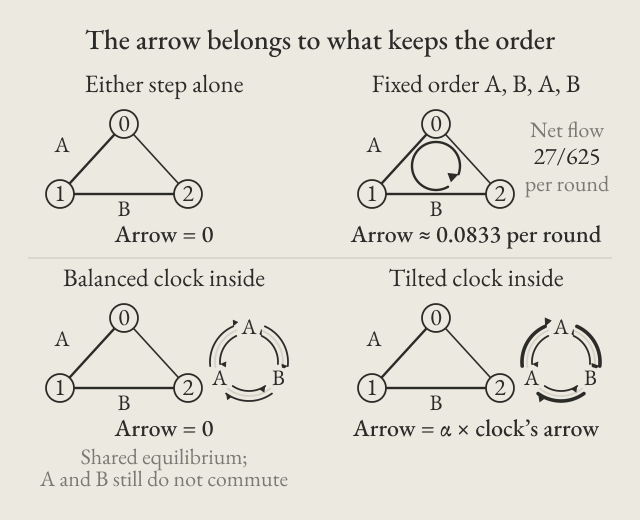
Now let a controller apply A, then B, then A, then B. Looked at once per round, the system follows a new rule, and that rule is no longer balanced. A net 27/625 of the probability, about 4 percent, flows each round around the triangle from 0 to 2 to 1 and back to 0. You can see why in the tables. Within a round, A can carry the system from 0 to 1 and B can then carry it on from 1 to 2. The reverse trip, from 2 through 1 to 0, goes easily only with B first and A second, the order the controller never uses.
The standard measure of how well a recording can be told from its reverse is called the entropy production. It is zero when the film cannot be told from its reverse at all. Here it comes out at
(27/625)(2 log(2905/1933) + log(1447/475)) ≈ 0.0833
per round, in the natural units of information theory: small, but certainly not zero. The exact formula, and the fact that it exceeds 1/20, are checked by a proof assistant, a computer program that verifies every logical step.
The paper is clear that this is no trick of bookkeeping: "This is a genuine divergence of a genuine Markov chain." But it is just as clear about whose arrow it is. "That is a property of the controller, not of either step." Played backwards, every round would run B before A, and the controller never runs a round that way.
Physicists know a cousin of this from Brownian motors. Switch an uneven landscape on and off on a schedule, and jiggling particles drift one way, although with the landscape held either way they would not drift at all. That comparison is mine; the papers do not make it, and they measure arrows as information, not as the energy budget of a motor.
Put the clock inside
What if nothing outside the system decides the order? The paper builds the controller into the system as a clock that goes round a cycle of three positions, so that forward and backward mean different things. Its three positions call for A, B and A again. The clock ticks forward or backward with equal probability, or stays put. At every moment a coin decides whether the clock ticks or the system takes the step its current position calls for. Call this the balanced clock.
The theorem at the heart of the paper, the protocol trap, says what happens. It first appeared in the programme's founding paper, and the Protocol Trap paper sharpens it and works it through. Suppose the clock is balanced on its own, and both steps are balanced around the same equilibrium, here the state of affairs in which all three states are equally likely. Then the whole system, clock included, is in detailed balance. Watched from its equilibrium, its arrow is zero over every stretch of time. No partial view shows an arrow either: watch only the three states and ignore the clock, and the recording still runs the same both ways. Meanwhile A and B still do not commute; A then B still differs from B then A.
The holonomy of the protocol is unchanged, but the arrow is gone.
The shared equilibrium is not a detail. If each step is balanced around an equilibrium of its own, a balanced clock can still leave an arrow; a separate example built to show this gives about 0.085. And the example needs three states. On two states, two steps that share an equilibrium always commute, so there is no order dependence to keep.
The arrow is the clock's arrow
Now tilt the clock, so that it ticks forward more often than back. The arrow returns, and the paper says exactly how much. The arrow of the whole system, which the paper calls the lifted chain, equals the clock's own arrow, scaled down by the fraction of moments at which the coin picks the clock.
The arrow of the lifted chain is the arrow of its clock, diluted by the fraction α of steps in which the clock is selected for updating.
With the coin choosing the clock half the time, and the clock moving on 90 percent of the times it is chosen, a clock that ticks forward three times as often as back gives the system an arrow of 0.2472 per step of the clocked system. At nineteen times as often, it gives 1.1925. (These are per single step, so they do not compare directly with the 0.0833 per round above.) The steps contribute nothing. All of the arrow comes from the clock.
A real arrow, not an artifact
It is tempting to conclude that the alternating chain's arrow was an illusion, an artifact of leaving the controller out. The programme's own papers say otherwise, and it is worth seeing how their view sharpened.
The founding paper, Foundations of Emergence Calculus, proved the protocol trap in January and drew a cautious moral: an apparent arrow in such a model must be traced to an outside schedule or to a drive, a built-in push such as a tilted clock. It also warned that a recording can seem to have a "spurious" arrow when too simple a model is fitted to it. The Protocol Trap paper, in its October version, keeps the arrow and gives it an owner, the controller. And To Lay a Stone with Six Birds, the next day, says it outright: "This arrow is real: it is an actual property of the scheduled process, not an artifact of fitting."
The point is that the balanced clock that erased the arrow does not run the same process as the controller. It can stall or tick backwards, so the steps no longer come in the fixed order A, B, A, B. To Lay a Stone builds the faithful alternative, a clock that always ticks forward and so reproduces the schedule exactly, and proves that putting that clock inside the system can never remove an arrow the schedule had. Its recording includes the clock and every step within a round, so it can only show more arrow, never less. In its own example, with different tables, the schedule's arrow over six rounds is 0.173783, the machine with the faithful clock inside shows 3.89111 over the same six rounds, and the version with the balanced clock shows 0. "Making the schedule autonomous did not remove the arrow; it can only add to it."
So the pieces fit together. Order dependence alone does not make an arrow. In these models an arrow needs something that drives the order, an outside controller or a clock that runs one way, and it belongs to that driver. The Protocol Trap paper's advice for anyone auditing a system for time asymmetry is to "ask where the order of operations comes from".
Holonomy does not certify an arrow.
What it does not say
Everything here concerns small chains that move in discrete steps. The protocol trap is about systems watched from their equilibrium; started somewhere else, even a balanced system can show an arrow that comes from the starting point, and the papers say so. (The faithful-clock result needs no such start.) The trap needs both conditions, a balanced clock and one shared equilibrium for the steps. A protocol that changes temperature can break the second. The glass model behind The Glass Remembers has a different equilibrium at each temperature, so cooling and reheating it does exactly that, and its paper says the theorem "does not apply as published" there. It proves a weaker replacement instead, a bound with an extra term, which holds only once the system has settled and under a further technical condition.
Entropy production is used throughout as a measure of how distinguishable a film is from its reverse. The paper is explicit that "A thermodynamic reading would require a physical model of the controller or reservoirs, which is not given here." Nothing here measures heat. What the results do settle is where to look for an arrow when steps that cannot tell past from future are run in order: at whatever runs them.
Drawn from Six Birds Protocol Trap: Holonomy Without Entropy Production (Tsiokos, 2026, version 2, doi:10.5281/zenodo.23120462), with To Lay a Stone with Six Birds (Tsiokos, 2026, version 2, doi:10.5281/zenodo.23131875), Six Birds: Foundations of Emergence Calculus (Tsiokos, 2026, doi:10.5281/zenodo.18365949) and Glass Is an Unclosed Layer (Tsiokos, 2026, version 2, doi:10.5281/zenodo.23118261). Every number is taken from the papers and holds only for their finite examples; the clock-bias values and To Lay a Stone's three values are floating-point results backed by exact arguments, and no new computation is claimed by this essay. The Brownian motor comparison is mine; on flashing ratchets see P. Reimann, "Brownian motors: noisy transport far from equilibrium", Physics Reports 361 (2002).