Papers · Foundations
Six Birds: Foundations of Emergence Calculus
The paper that started it: theories as fixed points, and six moves you cannot avoid.
In plain words
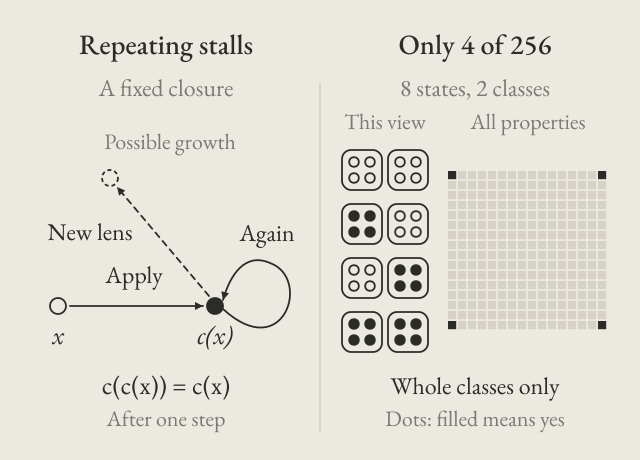
A theory is a fixed point of an idempotent operator. Apply it twice and nothing more changes. Open endedness then means changing the operator, not iterating it.
Under two mild assumptions, that processes compose and that you only see the system through a bounded interface, six primitive closure roles arise canonically. Those are the six birds.
The paper defines a computable idempotence defect, so objects at a timescale can be tested. It defines the arrow of time as a divergence between a path and its reverse and proves coarse graining cannot increase it. A counting lemma shows definable predicates are exponentially rare, so genuine extensions are the norm.
What it shows
- The six primitives derived rather than postulated.
- A total variation idempotence defect for packaged objects.
- An anti saturation mechanism for strict ladder climbing.
What it does not claim
A math only framework; no empirical claim is made.
Cite
Tsiokos, I. (2026). Six Birds: Foundations of Emergence Calculus. Zenodo. https://doi.org/10.5281/zenodo.18365949