Papers · Preprint · v3
To Wake a Stone with Six Birds: Audited Life-Like Signatures in Toy Substrates
What survives when life-like signals in a simulation are held to explicit controls.
In plain words
Simulations of life are easy to over-read. An arrow of time can come from a hidden schedule or a bookkeeping error. A recovery score can be positive by construction. A decoder can look clever only because the labels repeat.
The paper runs two synthetic worlds, a particle system and a layered lattice, and starts from a null with no schedule and no drive. It then switches the six operations on one at a time and credits a life-like claim only if it survives a matched control.
Four results do. Null runs calibrate near zero. Turning on drive, with nothing else changed, moves three context statistics from magnitudes below 0.007 to between 0.35 and 0.87 in every seed. Maintenance under imposed hazards holds up, with its costs recorded. And a frozen decoder reads injected labels perfectly under randomized assignment, while sham runs fail the same test.
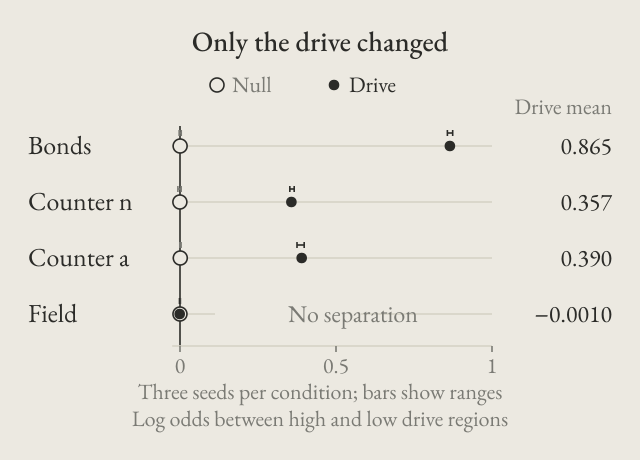
A schedule does change coarse behavior, cutting current by 10 to 28 percent. But a schedule is a clock someone imposed, so it counts only as a diagnostic.
The paper also reports what failed. Earlier attempts at semantics missed their gates, and version 3 withdraws the p-values of four phases after an audit of the paper and both simulators.
What it shows
- A clock is an arrow: a deterministic schedule can carry an arrow that a coarse lens hides, so it cannot be credited to the substrate.
- Drive separated from a matched null in both substrates.
- An exact randomized test for decoders, and a proof of why circular shifts cannot certify a periodic schedule.
- Small Lean proofs of the finite facts behind these points.
What it does not claim
No biological life, no autonomous open ended evolution, no exact path space entropy production, no measured closure and no strict definability separation. The substrates have no reproduction or heredity. The decoder reads injected labels; nothing shows meaning beyond them. Several tables reproduce results reported from the experiment repositories, without a fresh rerun.
Cite
Tsiokos, I. (2026). To Wake a Stone with Six Birds: Audited Life-Like Signatures in Toy Substrates. Zenodo. https://doi.org/10.5281/zenodo.23366543