Papers · Preprint · v3
To Count a Stone with Six Birds: A Mathematics is A Theory
When is a limit safe to take?
In plain words
Many higher objects in mathematics are defined as limits or completions. It is often unclear when a large discrete protocol really admits a stable continuous closure.
The paper turns Six Birds into a method for this. Stage a discrete substrate by refinement, keep a ledger of defects, and accept a packaged object only when defects shrink or stabilize.
The formal core is checked in Lean 4 with mathlib: the exact finite difference product rule, a limit bridge to the Leibniz value, the classification of derivations of polynomials, and the two contracts that make packaging well defined. Four numerical exhibits then audit concrete closures. For the zeta function, two staged routes agree ever more closely where the series converges, but on a grid in the critical strip the same naive truncations drift apart, to a mismatch of 5.0 × 10¹². In an Ising partition polynomial, shrinking the negative couplings to zero pulls the zeros onto the unit circle, an instance of the Lee–Yang theorem.
What it shows
- A defect ledger discipline for closure claims.
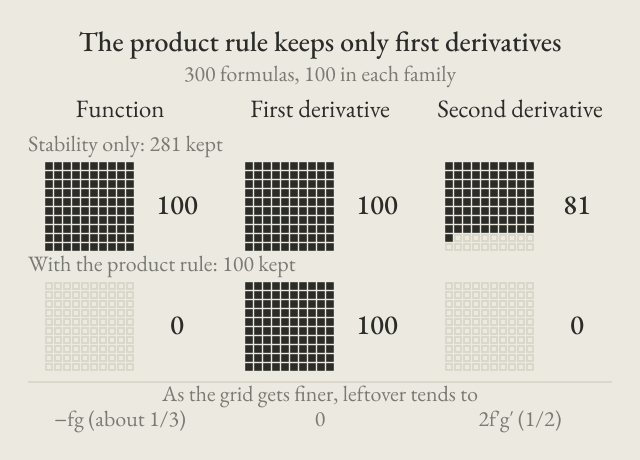
- Stencil filtering in which a shrinking product rule defect keeps only the first derivative stencils.
- Controlled separations between feasible closures and artifacts.
What it does not claim
No theorems about zeta or the distribution of its zeros.
Cite
Tsiokos, I. (2026). To Count a Stone with Six Birds: A Mathematics is A Theory. Zenodo. https://doi.org/10.5281/zenodo.23131954