Posts · Foundations
Forgetting Makes a Law
Four states and a rule that swaps them. Seen in three categories, the system obeys no law of its own. Merge two of the categories and an exact law appears.
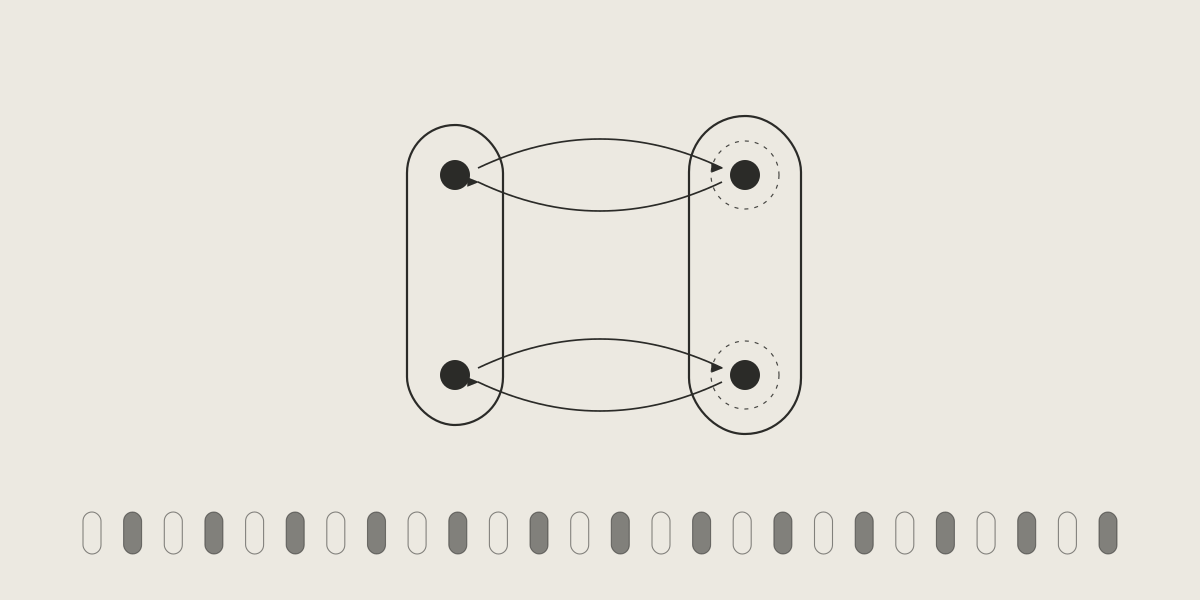
A small ferry crosses a river and comes back, over and over. It runs in one of two lanes and never changes lane. A clerk keeps a log. When the ferry is on the near bank, the log says only "near". When it is on the far bank, the log says which of the two far docks it tied up at.
Now ask the log to predict its next entry from its current one. It cannot. After "near", the next entry might be either dock, and which one depends on the lane, which the clerk never wrote down. (Someone reading back through the whole log could work the lane out. The question here is the strict one: does each entry settle the next?)
Tell the clerk to stop noting the docks, and the log becomes perfectly predictable: near, far, near, far, forever. The clerk now records less than before, and the record obeys an exact law that it did not obey when it held more.
The ferry is my dressing. Underneath it is the smallest example of a result in Six Birds Foundations VIII, a paper about what happens to laws when a description throws detail away. It belongs to Six Birds Theory, a programme that studies how new layers of reality become real. The paper's own summary of the example is one sentence:
Forgetting a distinction has created a law.
The example, exactly
Take four states, 0, 1, 2 and 3, and a rule that swaps 0 with 2 and 1 with 3. Suppose an observer can only tell which of three categories the system is in: {0, 1}, {2} or {3}. In the paper's words, "This description has no exact dynamics of its own." States 0 and 1 look the same to the observer, but the rule sends them to 2 and 3, which look different. So the observer cannot predict the next observation from the current one.
Now merge 2 and 3. The observer sees only {0, 1} or {2, 3}. The rule sends every state in the first group into the second and every state in the second group into the first. The coarser description has an exact law: the two groups swap.
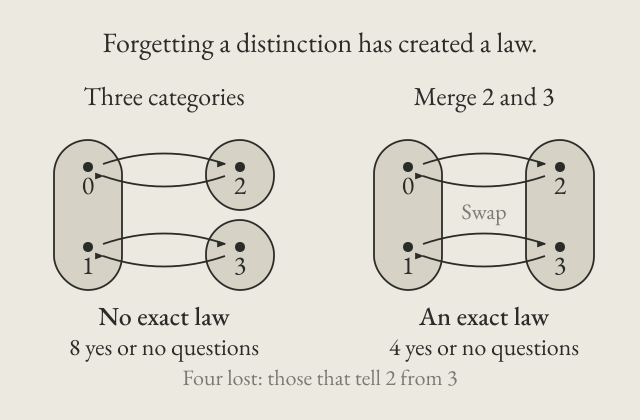
That is the ferry. States 0 and 1 are the ferry on the near bank in its two lanes, and states 2 and 3 are the two far docks. The paper calls the troublesome pair, two states that look alike but go to places that look different, a split pair. A description has a law of its own exactly when it has no split pair. There are two ways out. Look harder: split 0 from 1, and the observer sees every state, which always has a law, the rule itself. Or forget more: merge 2 with 3.
What was paid
The repair has a cost, and in one natural currency, yes or no questions, the paper counts it exactly. A description with k categories can answer exactly 2k yes or no questions about the state, one for each way of choosing which categories count as "yes" (counting the two trivial questions whose answer is always yes or always no). The three-category description answers 23 = 8 questions. The merged one answers 22 = 4. The four that were lost are exactly the ones that tell 2 from 3: is the state 2, is it 3, is it 0, 1 or 2, and is it 0, 1 or 3.
So the merged description knows less and predicts its own next step perfectly. The paper puts it as "more autonomous law with fewer available distinctions". A log that said nothing at all would be predictable too, trivially. This one still says something, which bank the ferry is at, and says it lawfully.
The smallest case, and every case
Could a smaller example do the same? No. The paper proves that nothing smaller works, provided the merged description keeps at least two categories and its law does not simply send everything into one of them. The argument is short. A law can only fail if some category lumps two states together. The merged description needs at least two categories, so the original needs at least three. Three categories with one of them doubled need four states. Drop those requirements and the bare failure already happens on three states, but there the only way to repair it by merging lumps everything into a single category, where the law says nothing.
At four states the paper goes further and finds every example. It checks all 256 possible rules on four states, every way of giving each state a next state, against all 15 ways of sorting four states into categories. Exactly 192 combinations work. Up to relabeling the states, they come in 9 distinct shapes. Of the 192, 144 have a merged law that keeps each category where it is, and the other 48 swap the two categories. Every one starts from categories of sizes two, one and one, and every one reaches its law after a single merge. Two independent programs agree on every count.
No exchange rate
If forgetting can buy a law, can you price it? Is there a rate, so many lost questions per law gained?
The paper's answer is no, and it shows this on a different kind of object, where laws are equations rather than next-step rules: small algebras, sets with a multiplication table. Its smallest example has three elements a, b and c. Any element times anything gives b if the element is a or b, and c if it is c. The law "x times x equals x" fails, because a times a is b. Now treat a and b as a single element. In the merged table every element times itself is itself, so the law holds. Merging bought a law here too.
To compare merges, the paper fixes one list of 150,975 candidate equations and counts how many each merge makes true. Two merges each squeeze four elements into two groups, so both lose the same 12 questions. One makes 548 of the equations true. The other makes none. A merge of three elements into two loses only 4 questions and also makes 548 true. And one family of merges loses more and more as it grows, 4,092 questions at twelve elements, while making nothing new true. So the number of questions lost does not determine the number of equations gained, even when you also know how many pairs were glued, and the gain does not determine the loss.
The paper is careful about the reach of this. It concerns three counts, on one stated family of algebras, all measured against one list of equations. Other ways of keeping the books are "a different question".
Finer is not better, coarser is not safer
The obvious reading of the ferry is that coarser is better. It is not, and the companion paper To Chart a Stone with Six Birds asks the question directly: does splitting a description into finer categories bring it closer to having a law of its own? It measures the distance by how differently two states in the same category send the system onward; zero means an exact law. Its answer begins, "Neither “yes” nor “no” is correct."
It scanned 1,665 pairs of coarse and fine descriptions of four-state systems, drawn from one designed family of systems plus a control built so that splitting hurts. Each pair was tested in four settings, two ways of filling in the missing detail, one step and two steps ahead. Splitting brought the description closer to a law in all four settings for 687 pairs, and pushed it further away in all four for 596. The rest mostly did not move at all. "Finer is not uniformly better, and coarser is not uniformly safer." The paper's own conclusion is that refinement is "motion in packaging space with no preferred direction". These counts describe that designed family, not a random sample of the world.
Some things do run one way. Splitting a category never loses a yes or no question. What it can lose is a law, as the ferry shows when you read it backwards.
To think is to forget
The paper opens with the reason this matters: "A coarse-grained description of a system is a bet that some distinctions can be dropped without losing what matters." Its examples are thermodynamics, which drops the positions of molecules, a model of a protein that drops most of its shapes, and a verification tool that replaces a program by a much smaller abstraction. Each one gives up detail and gets back a description that can be reasoned with.
Jorge Luis Borges told the opposite story in 1942. His character Funes falls from a horse and wakes with a perfect memory, and with it he loses the power to think in general terms. "Pensar es olvidar diferencias, es generalizar, abstraer": to think is to forget differences, to generalize, to abstract. The four-state example makes one sliver of that exact. With the far docks told apart, the clerk's log has no law of its own. With that one difference forgotten, it has one.
An earlier essay here, The Object Is the Shadow, looked at the same obstruction from the other side: a description that lumps together states the law treats differently, so that the law cannot be read off from it. The ferry adds the other half. Sometimes what lets a law through is forgetting more.
What it does not say
The phenomenon is not new, and the paper says so. That a coarse description can have an exact law of its own is the classical idea of lumpability, which goes back to Kemeny and Snell's textbook on Markov chains. What the paper adds is in its own phrase: "The contribution is sharpness rather than new phenomena." The proved minimum of four states, the complete count at four and the counterexamples to an exchange rate are what the paper lists as new.
Everything here is finite and exact. Nothing in it is a claim about real gases, proteins or programs; those are the paper's motivating examples, not its results. The counts at four states come from an exhaustive search and hold for what was searched. Coarser is not a recipe, and neither is finer.
Drawn from Six Birds Foundations VIII: A Typed Calculus of Coarse-Graining (Tsiokos, 2026, version 1, doi:10.5281/zenodo.23097905), with the refinement counts from To Chart a Stone with Six Birds (Tsiokos, 2026, version 2, doi:10.5281/zenodo.23120459). Every number quoted here is taken from the papers and holds only on their finite examples; no new computation is claimed by this essay. The ferry is an illustration of the paper's four-state example, not part of it. The Borges line is from "Funes el memorioso" (1942); the translation is mine. Kemeny and Snell are as cited in the paper.