Papers · Preprint · v2
Six Birds Protocol Trap: Holonomy Without Entropy Production
Route dependence is not an arrow of time.
In plain words
Update steps that do not commute can look like time asymmetry. The paper shows how to tell them apart.
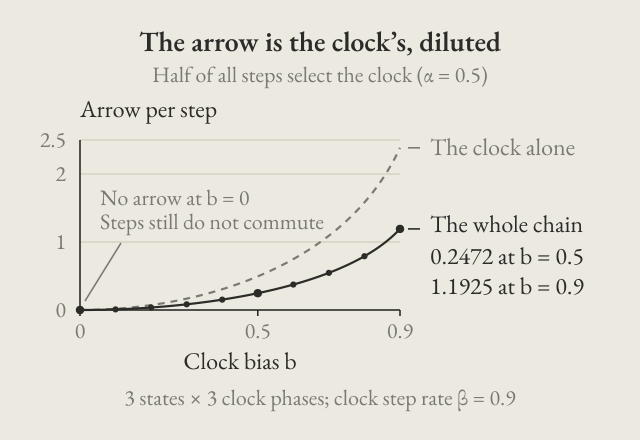
Take two kernels on three states, each reversible, that do not commute. Compare two ways of running them. First, an external controller applies one and then the other. Second, the protocol phase becomes part of the state, as a clock updated at random alongside the system.
Scheduled: a steady current around a cycle, with entropy production of about 0.0833 per step. Autonomous with an unbiased clock: zero at every horizon, even though the steps still do not commute. Bias the clock and an arrow returns, all of it coming from the clock.
What it shows
- A clean null versus driven separation on a three state benchmark.
- Holonomy and directionality decoupled.
- For every finite stationary Markov chain, path reversal divergence over T steps is T times the entropy production rate, even when both are infinite.
- Main theorems and exact values checked in Lean 4, with one general case argued by hand.
What it does not claim
Conclusions are for finite state discrete time kernels and the lift studied.
Cite
Tsiokos, I. (2026). Six Birds Protocol Trap: Holonomy Without Entropy Production. Zenodo. https://doi.org/10.5281/zenodo.23120462