Papers · Preprint · v2
To Create a Stone with Six Birds: Emergent Geometric and Thermodynamic Regimes from a Minimal Stochastic Substrate
A random walk, six switches, and what survives coarse-graining.
In plain words
Start with a finite state space and a random kernel. Add an algebra of six primitives whose interactions are set by a six by six enable matrix. That is PICA, the Primitive Interaction Closure Algebra.
For each timescale and lens, build the induced macro kernel and audit it along a resolution ladder.
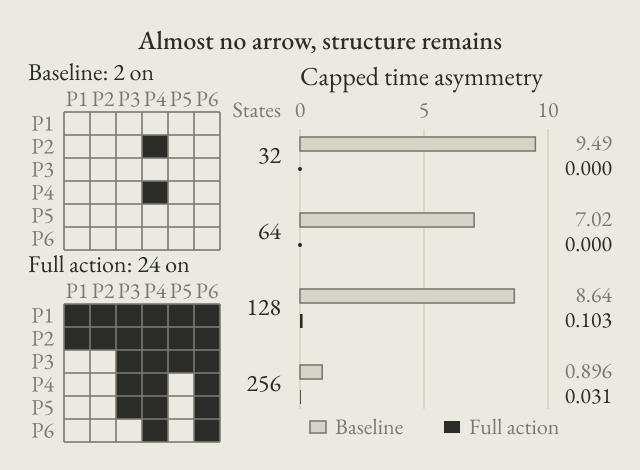
Across 2,070 runs of a prescribed suite of 69 configurations at three sizes, plus 237 runs at a fourth, switching on the full set of interactions keeps a capped measure of time asymmetry far below that of a two cell baseline at every size. Its effect on structure depends on size. Geometric regularity is protocol dependent: one alternative coarse-graining lens shows consistent gains, the default resolution ladder does not.
What it shows
- Full activation keeps the measured arrow of time near zero while structure is retained.
- In the native audits, configurations do not fall into cleanly separated regimes. Under one fixed instrument, a six cell generator suffices for low asymmetry with retained structure, and deleting one of its cells breaks it.
- A prescribed ablation suite of 69 configurations, with PICA as a reusable object for other systems.
What it does not claim
These are finite size, protocol specific findings about a computational model, not physical laws. PICA is offered as a tool, not as a claim about nature.
Cite
Tsiokos, I. (2026). To Create a Stone with Six Birds: Emergent Geometric and Thermodynamic Regimes from a Minimal Stochastic Substrate. Zenodo. https://doi.org/10.5281/zenodo.23154591