Posts · Foundations
A Hundred Instruments, One Blind Spot
A hundred calibrated instruments with independent histories agree, and the question is exactly as open as before. One instrument of the right kind can settle it.
A hundred instruments, each carefully calibrated, each publishing its reading for anyone to check, each with a declared history that shares nothing with any other's. They agree with one another perfectly. And they tell you nothing at all about the question you are asking.
That is the opening example of Six Birds Verified XIV: Objectivity Without Finality, a paper in the Six Birds research programme. Its setting is a tiny world of four possibilities. A world is a pair of bits, x and y, and the question is: what is y? All hundred instruments measure x. So the world (0, 0) and the world (0, 1) look identical to every one of them, and the question is exactly as open as before they started.
The moral fits in one sentence: "Agreement and independent origins are not separation," where separation means telling two worlds apart. The fix is not a hundred and first instrument of the same kind. It is one instrument of a different kind. In the paper's version, the only instruments available read x, so the new test first makes a declared intervention, a controlled change before the reading, that swaps x and y, and then reads x. In effect it reads y, and it settles the question at once.
In real life the mistake is rarely this obvious. Think of a hundred polls that all ask the same leading question, or a hundred labs repeating a study whose design cannot tell two explanations apart. (These comparisons are mine, not the paper's.) The agreement is real, and so is the blind spot.
When a question is settled
The paper makes this exact. Call a question settled by a community of instruments when the answer can be read off from their public readings. The theorem: a question is settled exactly when, for every two possible worlds that give different answers, at least one calibrated public instrument reads those two worlds differently. When that holds, the answer is a unique function of the readings.
Notice what this does not ask for. It does not ask that the instruments agree, that there be many of them, or that they have independent pedigrees. For settling a question, a hundred instruments that all draw the same distinction draw it once. Copies are not useless, as the next section shows, but no number of copies draws a distinction that none of them draws.
It also asks for calibration, and the paper shows that this is separate. An instrument whose labels have been swapped tells exactly the same worlds apart as a correct one, and still reports the wrong answer every time. You could fix it by flipping its answers, but only if you knew it was flipped, and nothing in which worlds it tells apart reveals that. Calibration is what supplies it. "Separation is not calibration."
Silence and lies
Instruments fail, and they rarely fail one at a time. Instruments that share an upstream source, the same supplier or the same reference standard, fail together. The paper groups instruments by the source they can fail with, and then counts, for each pair of worlds with different answers, how many independent groups tell that pair apart. The smallest of those counts is the question's margin, which the paper calls its target distance.
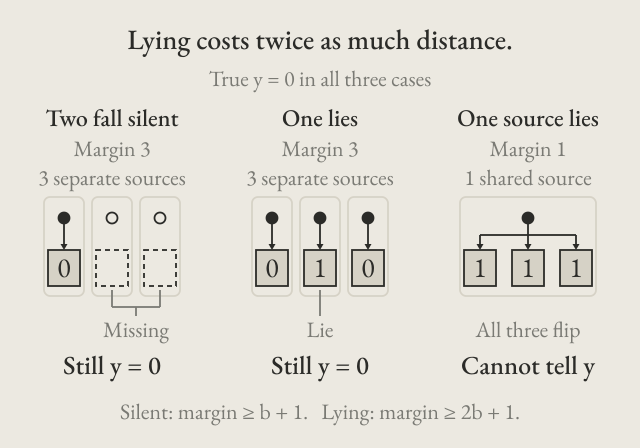
Two kinds of failure have exact thresholds. A group can fall silent, so its readings go missing and everyone knows they are missing. Or a group can lie, reporting wrong readings that look like real ones. To survive any b silent groups, the margin must be at least b + 1. To survive any b lying groups, it must be at least 2b + 1.
Lying costs twice as much distance.
The reason is simple once said. A silent group announces itself: you know which readings are missing and decide from the rest. A lying group does not. Whoever reads the reports has to tell the true world apart from a world in which some other group is the one lying, so enough independent groups must still tell the two apart after both possible liars are set aside. That takes roughly twice the margin, which is where the paper's slogan comes from.
The paper's example uses three instruments that read y, giving 000 for one answer and 111 for the other. If they come from three separate sources, any two can fall silent and the answer still comes through, and any one can lie and the answer still comes through. If all three share one upstream source, they are really one group, the margin is 1, and a single lie defeats them.
These thresholds are not new. The paper credits them to coding theory, where function-correcting codes and erasure decoding work the same way, and notes that the contrast between silence and lies "echoes crash and Byzantine faults in agreement protocols", where the thresholds count copies rather than distance. What the paper does is apply them to communities of instruments and their sources.
Translating between communities
This matters whenever two fields, or two labs, want to compare results. When can two communities translate each other's readings exactly? The paper's answer is that they must draw the same distinctions, and then the translation is unique. Equal richness is not enough. A community reading only y and one reading only x each have two possible readings, but no rule turns one into the other, because worlds the first lumps together the second tells apart.
Settled is not final
A panel, the paper's word for a fixed list of questions with the instruments assigned to answer them, can do everything it was asked and still leave questions open. The paper's example: on the same four worlds, a panel that reads y answers the question about y perfectly and says nothing about x. "That is sufficiency, not finality." A panel settles every question you could ask about its worlds only when its readings tell every world apart. Then it answers all sixteen possible yes or no questions about the four worlds at once, since each of the four worlds can be a yes or a no.
Getting there can also stall. A community that keeps adding instruments can go a long time without learning anything new, as when it adds copy after copy of an instrument that reads x, and then jump forward the moment the right one arrives. The paper proves that the improvements can only happen finitely often, but you cannot tell from a long pause that the last one has happened: "a pause does not mean it has stopped".
The paper sets this against Charles Sanders Peirce's idea of truth: "In Peirce's account, truth is the opinion fated to be agreed on by all who investigate; here no finite panel is fated to settle every question unless its readout already separates all worlds, and progress comes by adding tests …" It is careful to label this as interpretation that goes beyond the theorems.
The same point with numbers
A companion paper, Six Birds Verified XII: The Geometry of Access, treats instruments that report numbers, each reading off some combination of the quantities being measured, and XIV names it as its own case for such readings. There, how much a community can learn is measured by how many independent readings it has, readings none of which can be worked out from the others, not by how many instruments. Three instruments that each read the same quantity count as one. "Repeating a probe adds nothing."
A third paper, Adequacy Residuals and Blind-Spot Currency, measures how much of a question is left unexplained by a set of measurements. In its example, adding a second instrument that reads the same quantity at twice the scale leaves the unexplained part exactly where it was, although there are now more instruments. Only a measurement that reaches the unexplained part helps. This connection between that paper and XIV is drawn by this essay, not by the papers.
What it does not say
The main paper's results concern a finite set of declared possible worlds and instruments that give the same reading every time. There is no noise and no statistics: "Statistical independence and confidence bounds need a declared joint law, which is not used." The results say when a community's readings settle a question within the worlds it has admitted, and the paper adds plainly that "whether the world set covers the world is a separate obligation."
Nor is any of this an argument against agreement. In the opening example, the agreement comes from every instrument reading x, which is fine as far as it goes. The point is the one in the paper's list of limits: "No truth from consensus. Agreement without separation is the blind spot of Example 5.2." A hundred instruments that agree may all be looking the same way. The question is always whether any of them is looking where the answer is.
Drawn from Six Birds Verified XIV: Objectivity Without Finality (Tsiokos, 2026, version 1, doi:10.5281/zenodo.23097945), with Six Birds Verified XII: The Geometry of Access (Tsiokos, 2026, version 1, doi:10.5281/zenodo.23097938) and Adequacy Residuals and Blind-Spot Currency (Tsiokos, 2026, version 4, doi:10.5281/zenodo.23086980). The results, examples and quotations are from the papers; Peirce (1878) and the coding and agreement literature are as cited there. No new result is claimed by this essay.