Papers · Preprint · v4
Adequacy Residuals and Blind-Spot Currency
How much does a second set of probes see that the first cannot explain?
In plain words
Two families of measurements look at the same system. One family is native to a layer. The other tries to dissolve the layer and see through it. The adequacy residual is the leftover: what the dissolving probes measure that the native probes cannot account for, at a given audit budget.
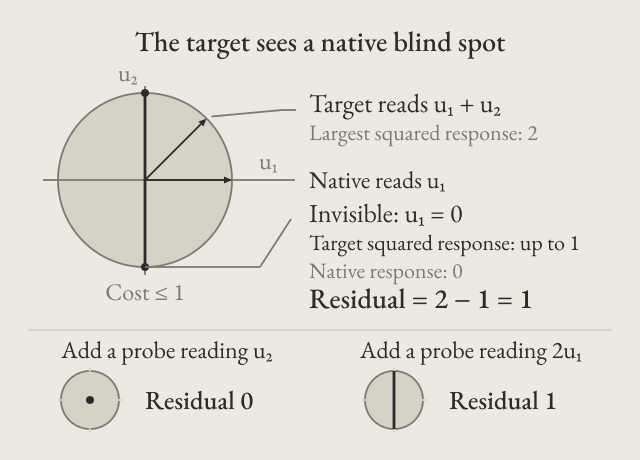
The paper turns that leftover into a calculus. It says how residuals compose, how they shrink under post processing, and how they move across bridges between layers.
When a declared budget fails, the failure becomes a concrete object: a vector with positive excess. That is a blind spot you can point at.
What it shows
- The residual is a Schur complement in energy scaled coordinates.
- Chain rule, data processing and transfer laws for residuals.
- A witness theorem that turns a failed budget into an explicit blind spot.
What it does not claim
It claims no novelty for the classical operator theory it packages, and does not claim residuals vanish in general.
Cite
Tsiokos, I. (2026). Adequacy Residuals and Blind-Spot Currency. Zenodo. https://doi.org/10.5281/zenodo.23086980