Posts · Mathematics
The Imaginary i Is Half of Turning Around
On three points you can reverse, but nothing does half a reversal. Add a fourth point and something does: a quarter turn whose shadow, done twice, is the reversal. Four points show what imaginary numbers do, at the smallest possible scale.
The equation x3 − 3x + 1 = 0 has three solutions, one between −2 and −1, one between 0 and 1, and one between 1 and 2. Every one of them is an ordinary real number. Yet a classical theorem says that no formula that starts from whole numbers and fractions and uses only arithmetic and real square roots, cube roots and so on can produce them. Cardano's formula, the old recipe for equations of this kind, does produce them, but only by passing through complex numbers, built from i, the number whose square is −1. Complex numbers appear in the middle of the calculation and cancel at the end, leaving three real answers. As a recent paper on proofs puts it, "The values are real; intermediate radicals need not be."
Why should a detour through numbers that are not real be the way to real answers? That is the small, sharp version of an old question, which Eugene Wigner made famous as the unreasonable effectiveness of mathematics. A paper titled Why Mathematics Even Works takes on a narrow piece of it. It cites Wigner, and then says, "our aim is narrower and mathematical." Its smallest example needs only four points. (The cubic is a different and harder story, which this post comes back to at the end.)
Nothing does half a reversal
Take three points, −1, 0 and 1, and the move that reverses them: send each point y to −y, so 1 and −1 swap and 0 stays put. Now ask for half of that move: a rule sending each of the three points to one of the three points, two of them possibly to the same place, which, done twice, gives the reversal.
There is none. The paper proves it with a parity argument and also lists all 27 possible rules, three choices for each of three points, to check them one by one. The idea is simple. A rule that sends two points to the same place still does so when done twice, and the reversal never does that. So the half move would have to shuffle the three points. But any shuffle of three things, done twice, either changes nothing or cycles all three round. It never swaps exactly two. The paper calls the small world the lower layer, and sums it up: "The lower layer is not missing reversal; it is missing a square root of reversal."
A fourth point
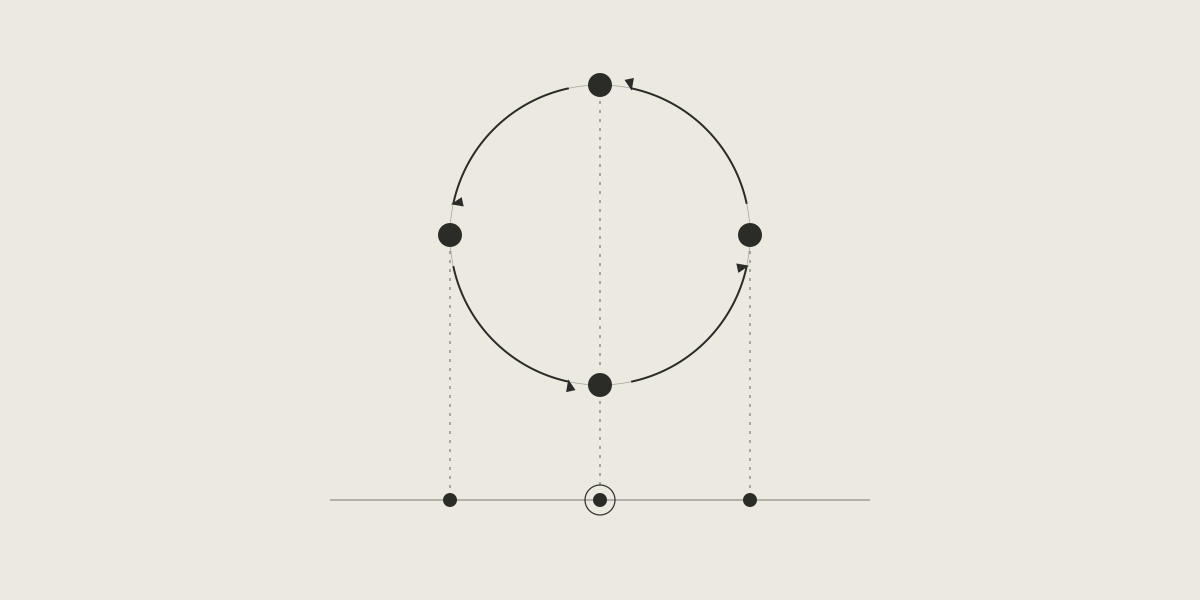
Now take four points instead, 1, i, −1 and −i, which sit evenly around a circle, and the quarter turn that moves each to the next: 1 to i, i to −1, −1 to −i, and −i back to 1. Two quarter turns make a half turn, which swaps 1 with −1 and i with −i.
Each of the four points casts a shadow on the original three. The shadow of a point is its real part: 1 lands on 1, −1 lands on −1, and both i and −i land on 0. Seen through the shadows, the half turn is exactly the reversal: it swaps the ends and keeps the middle in the middle. So the quarter turn is half of a move whose shadow is the reversal.
The catch is that the quarter turn has no shadow of its own. The points i and −i cast the same shadow, 0, but the quarter turn sends them to −1 and 1, whose shadows differ. Anyone watching only the shadows would see the middle point go to the left end sometimes and to the right end other times, with no rule they could state. In the paper's words, "The real shadow cannot tell i from −i; the quarter-turn can." Only the result of doing it twice comes back down as something the shadow world can see.
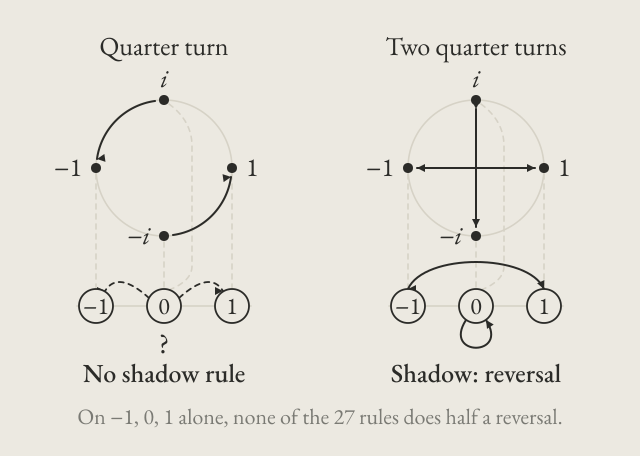
Four points is the smallest bigger world that works. The paper proves that any finite such world, in which every point of the small world is somebody's shadow, needs at least one point more than the world it shadows, so here at least four. The reason is the catch just described: the hidden step only works if two points share a shadow and go to different places, and two points sharing one shadow means one point more than there are shadows. It does not claim there is one best bigger world; it gives examples with five and eight points that do the same job in other ways.
Where the complex numbers come from
The four points are already enough to show the effect. The full complex numbers appear when one more thing is asked of the half step: that it act on quantities in the ordinary linear way, respecting addition and scaling. No such step exists on the real line itself: a linear step on the line just multiplies by some number a, doing it twice multiplies by a2, and a2 is never negative, so it can never give −1. One does exist on a plane, a quarter turn, and the paper shows that anything with this property behaves exactly like multiplication by i. Numbers built from it are the complex numbers, written ℂ.
Thus the continuum of complex numbers is not needed to witness non-descent, which already happens with four phases; ℂ is what one obtains when the hidden half-step is required to act linearly.
Here the four phases are the four points, and "non-descent" is the paper's word for the quarter turn's problem: it does not descend to the shadow world, because it has no counterpart there.
When the detour is forced
So far this shows that a detour can help. The paper also gives conditions under which it must look like this. Its theorem has four conditions. First, the small problem asks for a root of some move, as the half reversal is a square root of the reversal, and every rule of the small world counts as a candidate, tested by whether repeating it gives the move. Second, none of those candidates works; here the candidates are all 27 rules on three points. Third, a calculation in a bigger world gets its result by repeating some step a suitable number of times, a multiple of two for a square root; here the quarter turn, done twice. Fourth, every point of the small world is somebody's shadow; here all three are. Then the repeated step cannot have a shadow of its own. It must be invisible from below.
The proof is short. If the step did have a shadow, then repeating that shadow would give a rule in the small world whose square is the reversal. That rule would be one of the 27 candidates, and none of them works.
The paper shows that three of the conditions cannot be dropped, with a counterexample for each. Drop the condition that every point is a shadow: take a "bigger" world of a single point whose shadow is 0. Doing nothing, twice, leaves its shadow at 0, which is just what the reversal does to 0, so as far as this world can tell, doing nothing twice returns the reversal, and doing nothing obviously has a shadow. Drop the multiple of two: the half turn, two quarter turns, applied once already gives the reversal in the shadows, and the half turn has a shadow, the reversal itself. Drop the root condition, by rigging the candidates so that they leave out a genuine solution, and their failure says nothing. No counterexample is given for the remaining condition. The theorem covers only calculations built by repeating one step, or a fixed sequence of steps, which the paper calls root and composition returns.
The claim that was taken back
The first version of the paper went further. It stated a general theorem that "every strict useful trace forces non-descending support": roughly, that whenever a calculation genuinely needs a detour through a bigger world, something in the detour must be invisible from below. The second version says plainly, "These statements are not established."
It also shows why the strong version fails. In a deliberately artificial example, the rules for checking a calculation insist that a certain step be used, so the step is indispensable. Yet the step is the identity, which changes nothing and has a perfectly good shadow. A step can be essential for bookkeeping reasons without being invisible from below. The narrower theorem above is what survives.
What it does not say
Back to the cubic. That example comes from a companion paper, Building What a Proof Needs, and it is a different kind of story: there the three solutions are already completely pinned down by the equation, so nothing about them is hidden. What is missing is a way to write them, since starting from fractions, real square roots and cube roots cannot do it, and the complex numbers supply that new operation. That paper verifies the formula by exact computer arithmetic and cites the impossibility of real radicals from a standard textbook. Neither paper claims that the cubic is an instance of the forcing theorem.
Nor does Why Mathematics Even Works answer Wigner. It explains one precise pattern, a richer world that distinguishes what a poorer one merges and sends back only what the poorer one can read, and it proves conditions under which part of that pattern is forced. The constructions are classical, and the paper claims no novelty for complex numbers. Its own last word on the big question is modest: "They do not offer a universal explanation of why mathematics works."
Drawn from Why Mathematics Even Works (Tsiokos, 2026, version 2, doi:10.5281/zenodo.23183149), with the cubic from Building What a Proof Needs (Tsiokos, 2026, version 1, doi:10.5281/zenodo.23097947). The results, examples and quotations are from the papers; Wigner (1960) is as cited there. No new result is claimed by this essay.