Papers · Preprint · v3
To Kill Three Stones with Six Birds: A Common Grammar for the SM, QM, and GR
One grammar, tried on the Standard Model and on quantum theory versus gravity.
In plain words
The six primitives are applied to two very different questions. First: which particle theories can even be built if you follow the grammar? In a census of 1,066 chiral gauge structures, only one family admits a clean breaking branch within the declared windows, and every clean branch breaks its SU(2) factor, so selection belongs to a structure together with a branch. An exact construction of the SU(5) embedding recovers the standard weak mixing angle of 3/8 under named conventions; it does not single out SU(5).
Second: is gravity a coarse-graining of quantum theory? On the paper's abstract carrier, neither readout is a quotient of the other; both factor through a common refinement instead, a fork rather than a ladder. The natural "quantize" and "curve" completions commute exactly, so non-commutation does not explain the difficulty. On finite graphs, the area of a minimal cut equals a sum of per-edge shadow prices, an exact linear programming duality.
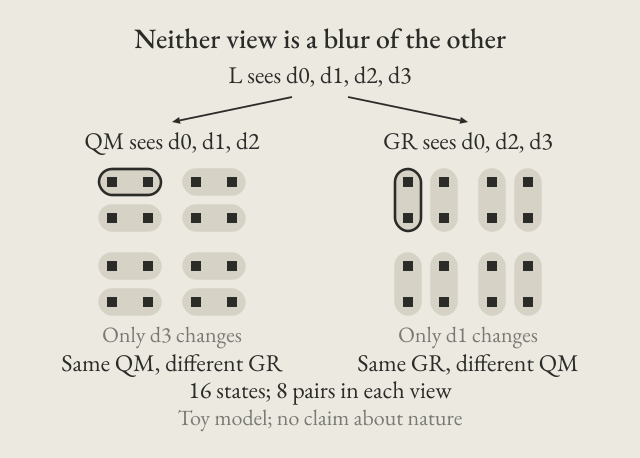
Version 1 advertised three physical predictions. A long verification pass found none of them was forced by the machinery. Version 2 retracted them, replacing them with three named construction programs, and version 3 keeps that scope.
What it shows
- A branch typed selection of gauge structure inside declared caps.
- An exact incomparability theorem for the quantum and gravitational partitions.
- Three open construction programs, with the missing object written down for each.
What it does not claim
It derives no measured constant and does not solve quantum gravity. Recurrence across domains is treated as evidence about method, not about nature.
Cite
Tsiokos, I. (2026). To Kill Three Stones with Six Birds: A Common Grammar for the SM, QM, and GR. Zenodo. https://doi.org/10.5281/zenodo.23120510