Papers · Preprint · v2
The Cosmological Constant as a Contingent Modulus: A Six Birds Demarcation of Dark Energy
Finite models that separate what fixes the constant from what they leave as input, with audits on public dark-energy data.
In plain words
What kind of term is the cosmological constant? What fixes its value? Why is its density comparable to matter today? What do current surveys say? The paper treats these as different kinds of question, and in each finite model it separates what the model determines from what it leaves as input.
In a convex closure problem, a budget carries a single positive price, and a common linear term only shifts that price while the budget binds. That gives a constant term the behaviour of a shadow price, as a theorem about budgets, not about the physical constant.
In a lattice model the convergence tests used to admit background values do not determine the background: all eighteen sampled offsets converge, fifteen pass the sixty update test, and neither readout recovers the input. Add a global density ledger and the absolute background becomes a gauge coordinate that the invariant record cannot recover. Whether our epoch is typical then depends on a declared prior, and none of five tested priors meets the declared concentration criterion.
On DESI DR2, Pantheon+ and compressed Planck data, preregistered audits find a fitted rewrite shape compatible with a constant, and flag structured dependence between supernova and BAO subsets. The best fit evolving history has a positive, regular density through its crossing of w = −1, so that history has two regular descriptions.
What it shows
- A proved budget price, which a common linear term only shifts.
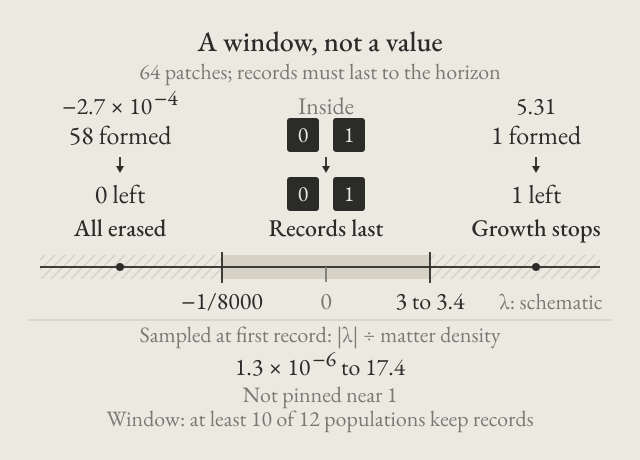
- An exact window of record keeping values in a toy universe, with the ratio to matter not pinned near one.
- A precise sense of contingent modulus: a background value the readouts leave undetermined.
- Audits on public data that find a rewrite compatible with a constant, and flag dependence between data subsets.
Version note
Version 1 (17 June 2026) claimed that no in-layer law can determine the value, and that the value shares a proved classification with the number of particle generations. To Kill Three Stones withdrew the grounds for both, and version 2 replaces those claims with the exact results above. It also replaces the sampled window with an exact one and restricts the statement about the phantom crossing.
What it does not claim
It does not derive the value of the constant, does not refute a fundamental cosmological constant, and does not identify the model's price with the physical constant. The window is a property of the toy's declared rules. It does not decide whether dark energy is a fluid, and the one real data detection is not a new physics signal.
Cite
Tsiokos, I. (2026). The Cosmological Constant as a Contingent Modulus: A Six Birds Demarcation of Dark Energy. Zenodo. https://doi.org/10.5281/zenodo.23218104