Papers · Preprint · v2
Institutions Are Strict Extensions of the Game
Reputations and norms are new objects, not shorthand for the game.
In plain words
Play a game once and theory predicts the play. Play it many times and reputations, norms and conventions appear. What are they?
The paper identifies the institution with the predictive state of play: the coarsest summary of history that still predicts what comes next. On a fully enumerated laboratory of all 32 deterministic memory-one rules, this state is a strict extension of the game. Two histories can agree on the current actions, the counts and the payoffs, yet predict different futures. The cost of using the game's vocabulary alone is a conditional mutual information, which splits exactly into a part that history can recover and a residual from rules that play has not yet revealed.
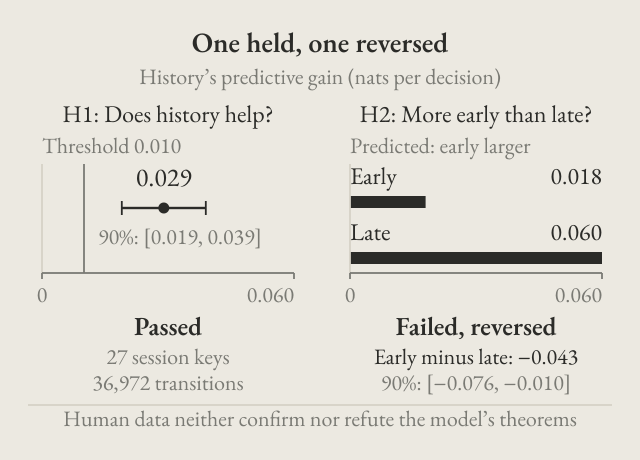
A published human Prisoner's Dilemma dataset was reanalyzed with hypotheses registered before the data were received. The main prediction held out of sample: a short window of history predicts the next action better than the current round alone. A more specific timing prediction failed, in the opposite direction: history dependence grows with experience. A third, that deeper windows add nothing, passed, though under an alternative pre-declared fold seed it lands in the equivocal band.
What it shows
- Institutional state is the coarsest predictive summary of history.
- It is not a function of the stage vocabulary on the finite carrier.
- Thresholds where cooperative conventions collapse are reproducible within a family of games, but three frozen transfer rules failed out of sample.
- Of the registered human-data tests, one passed, one failed in reverse and one passed fragilely; all are reported.
What it does not claim
Claims are scoped to the declared carrier, protocols and dataset.
Cite
Tsiokos, I. (2026). Institutions Are Strict Extensions of the Game. Zenodo. https://doi.org/10.5281/zenodo.23118272