Papers · Preprint · v3
Self-Dual Trace Confinement: A Six Birds Structural Law for Formed Closures Under Involutive Self-Duality
When a mirror symmetry forces an obstruction to vanish.
In plain words
Some systems come with an involution: a mirror that, applied twice, gives back the start. Split any object into a part the mirror keeps and a part it flips.
The theorem: if a sequence of positive bounds dominates the flipped part, and the trace of those bounds goes to zero, then the flipped part is zero, and when a separating odd readout is present, all visible mass sits on the fixed points of the mirror. The mathematics is elementary. Self-Dual Trace Confinement itself is a named hypothesis, not a theorem: that in specified settings such bounds are supplied by independent structure. For a given ledger it is equivalent to confinement, and it cannot hold for all mirrors.
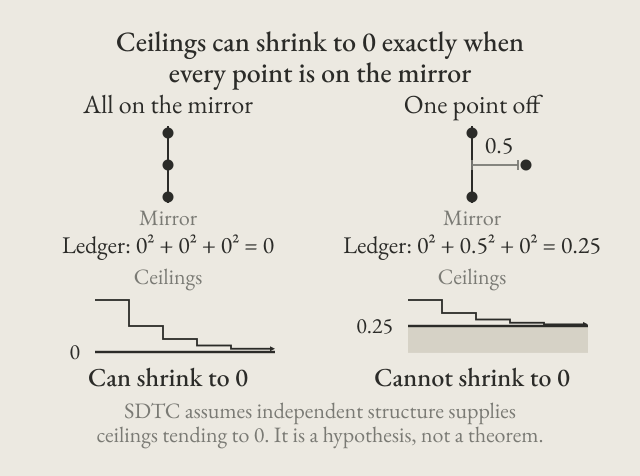
The paper builds the supporting apparatus and lists exactly what any concrete application must supply.
What it shows
- The duality confinement membrane theorem.
- Qualitative and quantitative versions of confinement.
- Every theorem formalized in Lean for positive trace-class operators on real Hilbert spaces of any dimension.
What it does not claim
It does not prove that the bounds exist in any application. Self adjointness of matrices is a worked instance, and the Riemann hypothesis for curves over finite fields, already a theorem of Weil, appears only as a test case.
Cite
Tsiokos, I. (2026). Self-Dual Trace Confinement: A Six Birds Structural Law for Formed Closures Under Involutive Self-Duality. Zenodo. https://doi.org/10.5281/zenodo.23086972