Papers · Foundations · v3
Six Birds Foundations IV: A Catalog of Layer-Agnostic Structural Laws
Fifty two laws that hold before you choose a substrate.
In plain words
What must be true for any layer, in physics, biology, economics or computation, to have stable records, lawful access, transport, symmetry, closure and limits?
This catalog states 52 laws in one normal form: setup, theorem, proof spine, case structure, interactions and nonclaims. That lets recurring failures, like failed descent or hidden predictive structure, be compared in one register.
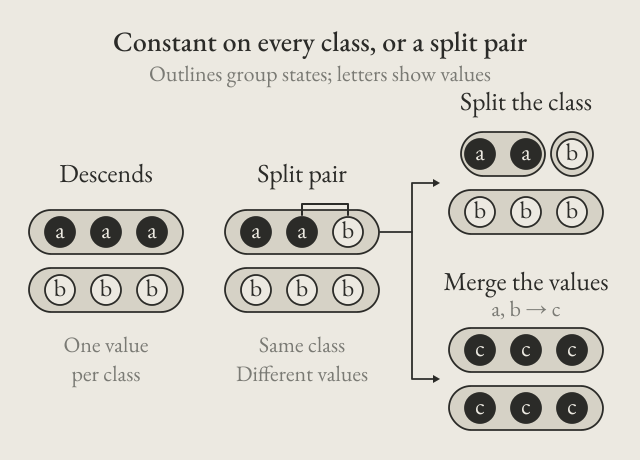
All 52 laws are formalized in Lean, with no axioms beyond Lean's standard ones. Fifty are faithful to the paper's statements; one is formalized in a restricted form, and one is faithful apart from a clause imported from a companion paper. A conditional law carries its source hypothesis explicitly, and the Lean proof establishes the implication, not the hypothesis.
What it shows
- A uniform template for structural laws.
- Explicit formalization status for every row.
- Conditional laws stated with their source hypotheses explicit, not as axioms.
What it does not claim
Not a reset of Foundations I to III, not a unification claim, and not exhaustive.
Cite
Tsiokos, I. (2026). Six Birds Foundations IV: A Catalog of Layer-Agnostic Structural Laws. Zenodo. https://doi.org/10.5281/zenodo.23087000