Papers · Preprint
Aligning AI Requires Aligning with Each Other: A Covenant
When an AI acts for some people but binds others, obeying the operator does not settle whether it acts rightly.
In plain words
An AI schedules shared equipment on a hospital ward. The hospital deployed it, but every allocation settles whose treatment waits. Obeying the operator does not settle whether it acts rightly by the patients it binds.
The paper makes three conditional arguments. The three body thesis: where a system's acts bind several claimants whose claims can conflict, completing alignment requires valid authorization among the humans concerned. The maintained relation thesis: under an adopted contract, alignment is assessed over histories and admitted futures, not on a snapshot. Today's queue can look fair while one patient is passed over week after week. The invoice thesis: evaluating a scheme rests on normative standards, so declare them as an itemized invoice, and let a reader refuse an entry and see which conclusions go with it.
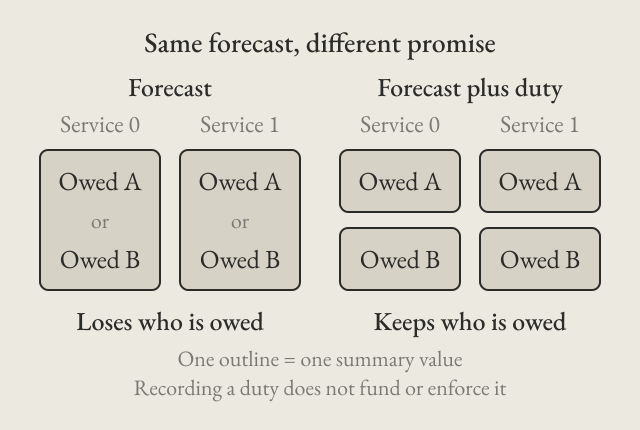
Five families of shortcut then fail on finite models. Parts that agree need not make an acceptable whole. Weighted sums can miss a compromise. More options need not reveal more about a person. Summaries can hide an unlawful revision of a ledger. And no committee can certify its own complete soundness.
Alignment does not require the AI to be conscious, though the ends it serves may require that some of those it serves are subjects. The paper closes with a proposal, the Carried Covenant: duties of aid and protection, three separate records, and a funded care floor. Finite models test parts of it, and the failures are reported along with the successes.
What it shows
- A nine gate contract for assessing a maintained relation.
- A proof that a forecasting summary can lose a protected duty, and the coarsest repair that restores it.
- Exact thresholds for service, repair, hosting and interruption in small games, with 127 Lean declarations covering generic parts of the work.
- A register of 17 alignment and institutional approaches, each marked as a missing mapping, not a verdict.
What it does not claim
It settles neither how to complete alignment nor whether any AI system is conscious. The three theses are conditional, and the mathematics supports them only within its scope. No result is claimed for real institutions or deployed systems, no quantitative bound on human disagreement is claimed, and the theses motivate the covenant without implying it. The new mathematics is self-reviewed, and passing every gate does not by itself make a system safe.
Cite
Tsiokos, I. (2026). Aligning AI Requires Aligning with Each Other: A Covenant. Zenodo. https://doi.org/10.5281/zenodo.23413556