Papers · Preprint
An Audited Born Calculus on a Pre-Physical Stochastic Substrate
What has to be built on a plain stochastic process, and what has to be added by hand, before the Born rule appears.
In plain words
Can a Born type probability structure arise on a substrate that is nothing but a finite stochastic process? The paper starts from a 32 state stochastic matrix, produced by a program that knows nothing of quantum theory, and asks what has to be built on top and what has to be added.
The contribution is an architecture, not a derivation. Every step is marked as derived, chosen, adopted or standard mathematics, along with the kind of check behind it.
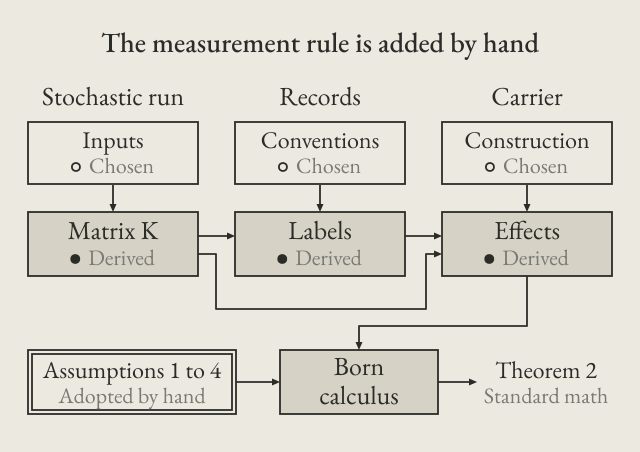
A chosen encoding takes the square root of a probability vector and projects it onto a two dimensional real plane. That gives a state with a squared amplitude rule, and it carries more than the records do. In all 2,122 census cases, some pair of states with identical labels gets encoded states whose probabilities differ by at least 1/25.
The measurement rule itself is added by hand. Four adopted assumptions give the calculus of a single rebit, a real two level system, and standard results then follow: densities are forced, no finite ontic model fits, and the calculus is preparation contextual.
The results also carry their limits. A predictor built from the construction wins registered aggregate comparisons on fresh seeds, and the cross terms matter. By median it is not the best compressed rule, and the uncompressed label law does better. A record only quadratic law failed its registered test. On the original worked case, no closed dynamics lifts to the carrier for one or two steps.
What it shows
- An audited map of a Born calculus, with each arrow labelled by what supports it.
- A census result: the encoded state strictly refines the records in all 2,122 rank two cases.
- Registered predictive evidence for the cross terms, reported with its limits.
- Formal coverage in Lean 4 with Mathlib of the general results and the census statements.
What it does not claim
It does not derive the Born rule or quantum theory from a stochastic model. The encoding and projection are chosen, the adopted rules are supplied, and the substrate does not produce the measurement rule. Whether the run forms this layer, whether closed dynamics exists in the census, and whether access survives noise all remain open. The calculus is one real two level system, not complex quantum theory.
Cite
Tsiokos, I. (2026). An Audited Born Calculus on a Pre-Physical Stochastic Substrate. Zenodo. https://doi.org/10.5281/zenodo.23261473