Papers · Preprint
A Closure Architecture for Consciousness
Eight conditions a self-maintaining system would meet, keeping apart what is proved, what is a reading and what is only conditional.
In plain words
Formal theories of consciousness often put a mathematical claim, an empirical claim and an ontological claim in one sentence. This paper keeps them apart.
It specifies eight conditions a self-maintaining system would meet: stable objects, a finer description the public one cannot recover, a predictive self-coordinate, a determining state hidden from a given interface, action credit, temporal closure, binding, and viability under maintenance.
Classic topics then become exact statements on small finite systems: privacy, reports, zombies, free will, introspection, binding and personal identity. For example, in this finite sense the explanatory gap is the certificate that a refinement is strict.
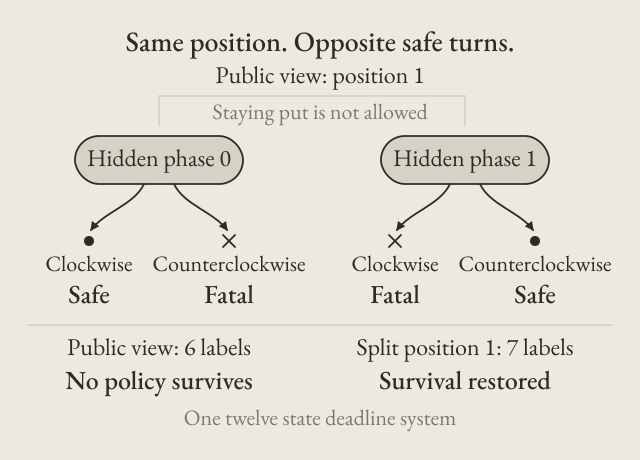
The anchor comes from a companion paper. In a twelve state system with a deadline, every policy that sees only public position fails, and the unique minimal repair splits one position. Staying alive forces a predictive self-coordinate there, and only there.
Whether meeting the conditions would be being conscious is split into graded objects. The bridge to realization is conditional: it rests on a soundness premise that is unproved and on a postulate.
What it shows
- A specification of eight conditions, each witnessed on small exact systems.
- Exact finite versions of classic topics, each with controls.
- More than two dozen counterexamples rejected by named Lean facts.
- A conditional bridge with both of its premises on display.
What it does not claim
It claims of no actual system that it is or is not conscious, offers no detector, and draws no unconditional ontological conclusion. The eight conditions are not claimed to be necessary or complete. No integrated instance has been exhibited, and evidence for different conditions comes from different small systems. No empirical data were collected, and no neighbouring theory is refuted.
Cite
Tsiokos, I. (2026). A Closure Architecture for Consciousness. Zenodo. https://doi.org/10.5281/zenodo.23233137