Papers · Preprint
When a Copy Is Not a Continuation
What would make a result a continuation of a source and not a copy, split into three separate checks.
In plain words
Teleporters, gradual replacement and uploads are usually asked one question: is the result the same subject? This paper does not try to settle that. It asks a prior question. When the organization described by a closure architecture is moved from one finite system to another, what would make the result a continuation of the source and not a copy?
The answer splits into three checks. Realization: does the target meet the conditions on its own state space? Lineage: does the episode pass through handoffs in which both systems are live at once, with no gap? Autonomy: once the source and every transfer aid are withdrawn, does the target keep itself going?
Similarity of endpoints settles none of the three. A detached copy passes realization and autonomy and fails lineage. A target that runs only while a resource is supplied fails autonomy.
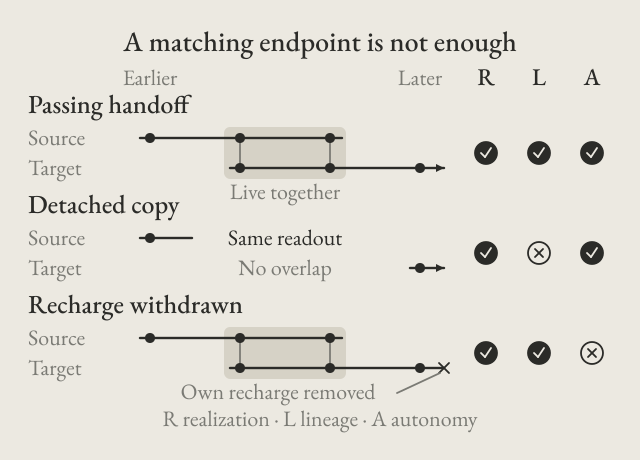
A continuation theorem shows that a handoff passing the certificate delivers all three, and three single edits of a working model each break exactly one. In a symmetric fork the source continues to both targets, and no rule that respects the symmetry can pick one. Ancestry alone leaves identity undetermined.
What it shows
- Three separately checked conditions for continuation, with countermodels for each shortcut.
- Agreement between neighbouring pieces does not give an acceptable whole.
- Continuation is a relation: under fission it need not pick out a single successor.
- Lean coverage: 25 of the 39 stated results are proved and the other 14 are checked as finite countermodels, with none left open.
What it does not claim
Nothing about consciousness, survival, numerical identity or substrate independence. Passing the realization check is not being conscious. On the strict models four of the eight conditions hold only in simplified form, and no model has both strict live overlap lineage and all eight conditions at design grade. Nothing here extends to noisy, large or continuous systems, or says any measurement of a real system identifies these structures.
Cite
Tsiokos, I. (2026). When a Copy Is Not a Continuation. Zenodo. https://doi.org/10.5281/zenodo.23233188