Papers · Preprint
Where Does Jagged Competence Come From?
Small networks with low average error and failures on particular inputs, traced through a task whose layers are known exactly.
In plain words
Jagged competence means low average error alongside failures on particular inputs. In a large system nobody knows which intermediate quantities a task needs, or whether the system computes and keeps them, so the word stays a description.
The paper builds a task from two exactly known layers. The lower layer adds up masses on a board. The upper layer predicts what comes next from a hidden mode set by the history, so two histories can end on the same board and need different answers. Small recurrent networks train on the upper layer alone, and every measurement is against exact ground truth.
The central finding is that learning the upper layer gives the network a jagged version of the lower one. The one sum that matters becomes readable, at 97 to 98 percent, while the network's misreads gather at the category cutoffs. Average error looks excellent even so: no run passes the tests on constructed histories, with a worst case error about twelve times the allowed bar. This explains part of the failures, not all of them. Of 42 diagnosed histories, 19 remain unexplained.
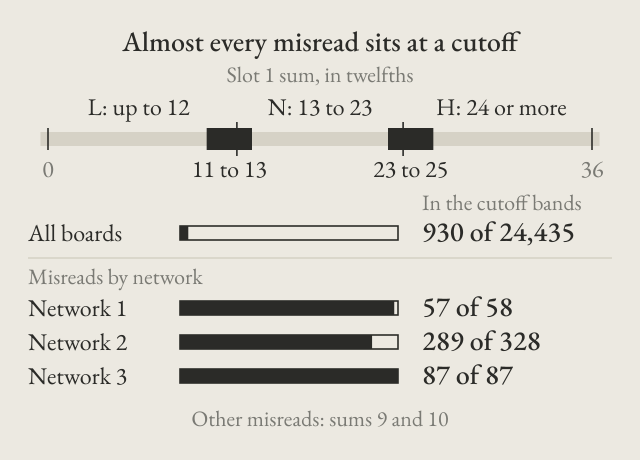
Having the sum is not the same as using it. The paper separates five achievements: recoverability, computation, access, preservation and reliable prediction. Networks trained to output the sums still misread boards when the output is not connected to the prediction. Connecting it cuts misreads between 1.3 and 17 times, and further training on prediction alone can erode exact sums within a single update.
What it shows
- Low average error does not establish reliability on constructed histories.
- Recoverability does not establish use.
- Matched experiments on target noise, access, encoding and erosion, each changing one factor.
- Even exact supplied sums do not guarantee reliable prediction.
What it does not claim
One task family, small networks of about 40,000 parameters, three seeds per condition. There are no theorems or machine checked proofs here. It does not show that a network builds an internal layer, and it does not show how free networks represent or use the sums. Transfer to larger systems is a test still to run. The result is not a test of the formal claims of Six Birds.
Cite
Tsiokos, I. (2026). Where Does Jagged Competence Come From?. Zenodo. https://doi.org/10.5281/zenodo.23094485