Papers · Preprint
Six Birds Verified XVI: Quantitative Closure Certificates
Four different ways a coarse description can be good, each given a number, with proofs of how they bound one another and where they come apart.
In plain words
A coarse description of a system, such as keeping one variable of a Markov chain, can be good in several different ways. It can predict well. The dynamics can stay close to the projection onto the coarse variables. The coarse variables can keep their information for a long time. Or all observables can decay quickly. These are often treated as one, and a rate obtained for one gets read as a rate for another.
The paper gives each its own number: descent, closure, retention and erasure, with a fifth for response to a changed input. It proves how they bound one another and shows on a single four state carrier where they separate. A system can flip its kept variable and still predict it exactly. Perfect memory is compatible with no closure at all.
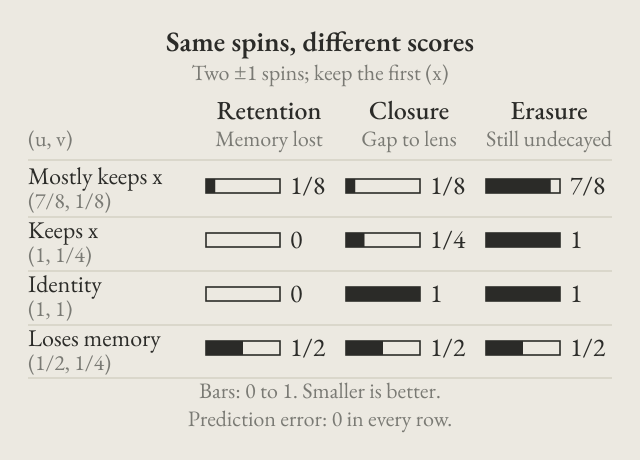
The main results give the best possible bound on prediction error from stage budgets, attained by real Markov kernels at every step at once. They also cover how errors add up across a hierarchy of descriptions, and how many stages a search for a good description can take. A rate is never free: rescaling the clock changes rates without changing any algebra, so every rate needs a declared normalization and a number.
Worked models carry explicit constants, including a Z2 gauge model with certified windows of coupling where the relaxation gap stays positive, and compact gauge models on continuous carriers.
What it shows
- Exact relations among four certificates, with explicit separations on one carrier.
- An optimal prediction envelope, attained simultaneously by Markov kernels.
- Certified gap windows for a gauge model, with explicit constants and exact reach for the certificates used.
- Results checked in Lean 4 with mathlib; the paper lists the exceptions.
What it does not claim
Most of the analytic tools are classical. What the paper adds is the separation of the certificates, the optimality result, the explicit constants, and an account of which numbers are supplied and which are derived. A sampler's gap alone is not a spatial or quantum gap, and no such bridge is constructed. Certified windows are where these certificates close, not where the model changes. The continuous results do not construct Yang-Mills theory.
Cite
Tsiokos, I. (2026). Six Birds Verified XVI: Quantitative Closure Certificates. Zenodo. https://doi.org/10.5281/zenodo.23589070