Papers · Preprint · v2
Decomposing the Bloch-Kato Fundamental Line: Adequacy and No-Go Results for the BSD Invariants
What one number about an elliptic curve keeps, and what it throws away.
In plain words
The Birch and Swinnerton-Dyer formula ties a curve to a product of numbers of different kinds. This paper sorts the richer data behind them into five columns: heights and regulator, analytic and period data, finite sources, local p adic data, and the assembly into one determinant line.
For each column a finite residual measures whether a given number is a linear readout of the admitted data, vanishing exactly when it is. The full data of each of the first four columns are adequate for their readouts, and the five columns together are adequate for a Bloch–Kato scalar normalized so that it forgets orientation. The comparisons from the columns to the Bloch–Kato line are stated as external inputs.
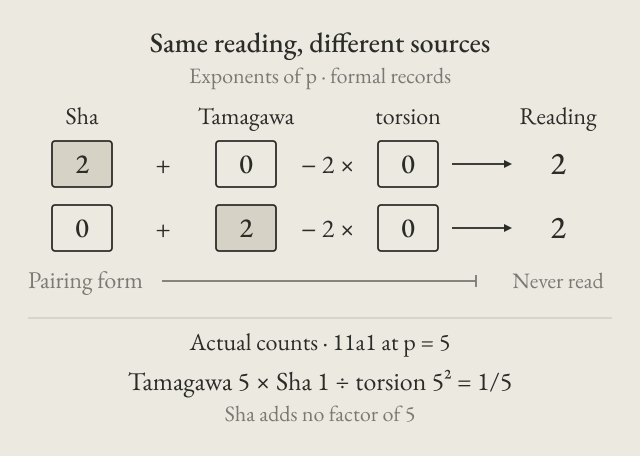
Other readouts lose information. The most concrete case: the curves 571a1 and 2045b1 share rank, Tamagawa numbers, torsion and the 2 torsion dimension of Sha, yet their 2 primary parts of Sha have orders 4 and 16. Many statements are checked in Lean 4 without external libraries, each labelled by exactly how much of it Lean proves.
What it shows
- A five column typed decomposition of the BSD invariants.
- Adequacy of each column's full data, and of all five for an orientation normalized scalar.
- Three fixed normalization points, and explicit places where scalar data is not enough.
What it does not claim
It does not prove BSD. Deep arithmetic inputs are carried as hypotheses.
Cite
Tsiokos, I. (2026). Decomposing the Bloch-Kato Fundamental Line: Adequacy and No-Go Results for the BSD Invariants. Zenodo. https://doi.org/10.5281/zenodo.23130789