Posts · Physics
The Glass Remembers
In 1963 a cooling glass reached its equilibrium volume and did not stay there. On a model glass small enough to compute exactly, the reason is now a theorem: its energy, down to the full distribution, cannot say what it does next.
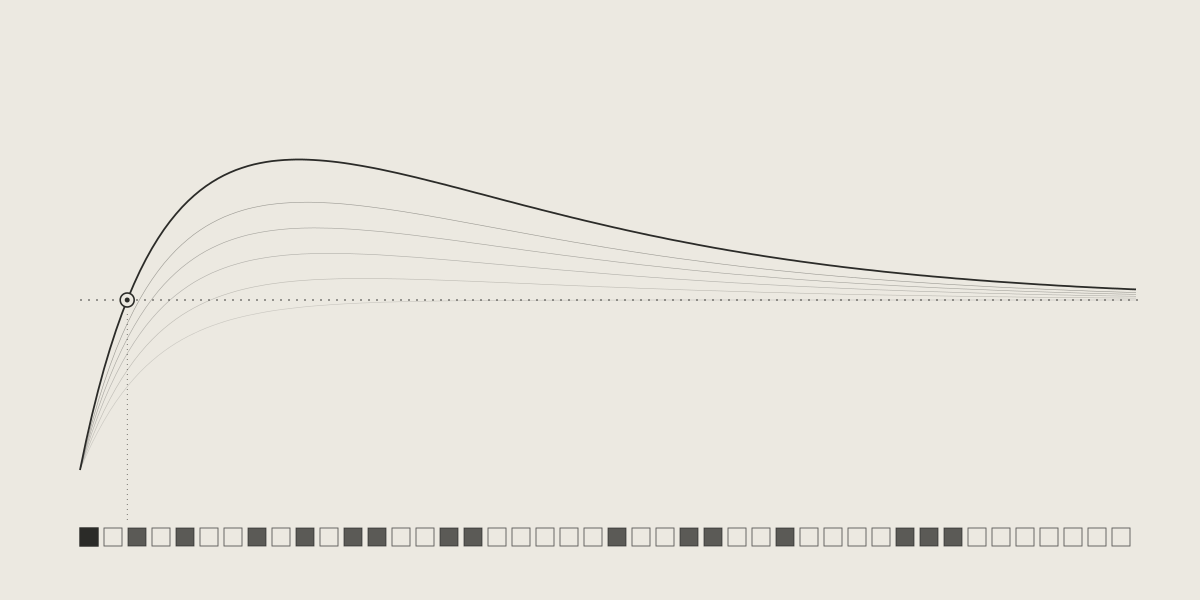
Take a piece of polymer glass and heat it until it settles. Cool it fast. Let it sit cold for a while. Then warm it partway back up and watch its volume.
The volume creeps toward the value that a sample kept at the new temperature would have. At some moment it gets there exactly. And then it keeps going. It overshoots, swells through a hump, and only slowly comes back down.
A. J. Kovacs reported this in 1963. Look at the sample at the crossing moment. By the two things being measured, it is identical to a sample that has sat at that temperature forever. The temperature matches and so does the volume. The settled sample stays where it is. The aged one moves. Same now, different later.
That hump is one face of what Philip Anderson called probably the deepest and most interesting unsolved problem in solid state theory. A glass and its liquid can agree in density, energy and every routinely monitored quantity, yet behave differently. For decades the field has searched for a static order parameter: something you could measure in a single snapshot that tells the two apart. No candidate has been universally accepted.
A new Six Birds paper, Glass Is an Unclosed Layer, asks the question underneath the search. It does so on a model small enough that the answer can be proved instead of argued.
Is the description closed?
Six Birds asks one question of every description: is it closed? A readout is closed when its present value fixes the statistics of its own future. Then you can write a law in the readout's own vocabulary, without ever peeking at anything finer. Temperature and volume would be a closed description of a glass if knowing them now told you everything they would do next.
When a readout is not closed, the shortfall can be measured. The paper calls it the closure deficit. It is how much more the full microscopic state tells you about the readout's future than the readout itself already does. It is zero exactly when the readout is closed. When it is positive, any law written in the readout's vocabulary has to carry memory.
The Kovacs hump is a direct demonstration that volume is not closed. So the paper asks three sharper questions. How far from closed is the readout? Can the failure be certified with a concrete example? And can any function of the readout repair it, or does the repair need something genuinely new?
A glass small enough to settle
The model is the East model, a standard toy glass. Picture a row of up to ten switches, each up or down, with a wall at the left end that is always up. There is one rule: a switch may flip only when its left neighbour is up.
That single rule makes it glassy. At low temperature up switches become rare. The few that remain are the only way anything else can move, so the row gets stuck, and the colder it is, the more stuck it gets. The energy is simply the number of up switches.
Because the row is short, every probability in the model is a ratio of whole numbers. The paper computes with exact fractions, not floating point. Where logarithms appear, each one is trapped between rational bounds. When a difference survives this, it is a proof, not a rounding error. That will matter later, when some of the differences are one part in ten billion.
Two comparisons anchor everything. In an unconstrained version of the model, where any switch may flip at any time, the energy is closed exactly. The deficit there is zero as a rational number, not merely small. The surprise is the second comparison. The East model is not closed even at equilibrium. How fast its energy can change depends on where the up switches sit, not only on how many there are. So equilibrium cannot serve as a zero baseline. It is an honest, nonzero one.
The first result clears that higher bar. Quench the row from hot to cold and let it age. At every tested horizon, its closure deficit is at least one and a half times the equilibrium value. The smallest certified ratio is 1.639.
Three pairs, each harder to dismiss
A deficit is a number. A witness is better. A witness is two preparations that look the same now and do different things later. The paper builds three, and each one answers an objection to the one before.
The Kovacs pair. Run the Kovacs protocol on ten switches: equilibrate hot, quench cold, age forty steps, then jump to an intermediate temperature. The mean energy starts below its new equilibrium value of 20/7, crosses it between the first and second steps, and peaks at step thirty five. This is the hump, computed exactly. No single step lands on 20/7, so the run is stopped at a random moment, weighted so that the average comes out exactly right. Now compare it with a sample that was at equilibrium all along, with the same mean energy. Hold both for five steps. The equilibrium sample stays at about 2.857. The aged one climbs to about 3.058.
Objection: you only matched the average. On eight switches the energy can take nine values. So there are exactly 29 = 512 yes or no questions you could ever ask about the energy. The paper checks every one of them on a constructed pair, and all 512 give both members the same answer. One structural fact tells the pair apart: whether the switch next to the wall is up. No question about the energy can be that question.
Objection: that pair was built by hand, and a present fact separates it, not the dynamics. The third pair answers this, and the trick is worth seeing. Take one real aging run. After the jump, record the energy distribution at ten successive moments. Each is a list of nine probabilities. Ten lists in nine dimensions cannot all be independent, so some weighted combination of them cancels to zero. Split the weights into their positive and negative parts. That gives two different ways of stopping the same run at a random moment, one on odd steps and one on even steps. Their energy distributions are identical. Not just the average: the whole distribution, exactly.
Then let both preparations run on. Their mean energies differ at every one of the next twenty one steps. The gaps are tiny, between about one part in ten billion and one part in a billion. They are also exact. Swap in the unconstrained dynamics for the continuation and every one of the twenty one gaps becomes exactly zero. So the separation comes from the East rule acting on the arrangement of up switches, which the energy does not record.
The consequence is sharp. On this run, no quantity computed from the current energy distribution can predict the future. That is not a matter of looking harder or measuring more precisely. Whatever you compute from that distribution, you compute the same thing for both preparations, and they do not share a future.
The field kept asking what the order parameter of glass is. On the class where certificates are affordable, the answer is that the question is asked at the wrong level of description.
Buying the memory back
If the energy is not enough, what is? For the Kovacs pair, one extra number suffices. The paper declares three candidates in advance, and each one separates the pair by itself. One is an index in the spirit of fictive temperature, the extra memory variable that glass physicists have used since the 1940s. The other two are structural: the expected number of neighbouring up pairs, and how often the switch next to the wall is up.
The third pair shows why the choice of number matters. The fictive temperature index is computed from the energy distribution, and on that pair the distributions are identical. So it fails there, as it must. The structural numbers still succeed. Memory is bought with a coordinate the old readout does not contain. In Six Birds terms this is a lift: a recorded, chosen, non unique addition, written into the ledger rather than slipped in.
The paper is careful about what this does not show. It does not show that one extra number is enough for real glasses. It does not show that fictive temperature fails in general. The field has long used models with several memory variables, and that general question stays open. What the pairs establish is the mechanism.
The failures are filed too
A memory signature can be faked, so the paper builds the fakes deliberately. One is a clock left out of the description. Others are a hidden bit, an incomplete list of experiments, and an effect that later washes out, plus a plain equilibrium sample as a control. The same mechanical classifier that accepts the Kovacs pair rejects all five.
Then it tries to predict. Six aging readouts measured on the East model were frozen and pinned by content hash. Interval predictions were registered for two other model families, and a frozen script scored them. Of the 22 predictions that could be scored, 8 passed and 14 failed. All 14 failures lie on the same side: the humps in the second family came later and larger than the intervals allowed, mostly at the colder intermediate temperature. The third family produced no hump at all. The paper proves why. A choice made to keep its arithmetic exact also kept that family's equilibrium from moving with temperature, so the protocol could never start it below equilibrium. That is a property of the family as declared, not a theorem about trap models.
Two of the framework's own hopes also fail on this model, and the paper says so. A fuller certification of the memory layer needs a map to have several stable resting states, and here it provably has only one. A hoped-for gap in a thermodynamic pressure turns out to be exactly zero in the long run. Every claim is pinned to its evidence. Every nonclaim is printed in an appendix. Lean, a proof assistant, checks the abstract theorems and the exported witness tables: 96 theorems, with no unproved steps.
What it does not say
The paper does not prove anything about all glasses, the continuum, or the ideal glass transition. It takes no side in the long argument over whether the glass transition is thermodynamic or dynamical. Its sentence “no static order parameter” is licensed only for the energy readout, on the declared models and sizes. Richer candidates are untouched. These include the amorphous order of random first order transition theory, configurational entropy, and local structure measures. The paper names them precisely so that nobody reads its result as a verdict on them.
That restraint is the point. A claim that holds exactly on a small class is worth more than a slogan that holds nowhere in particular.
Glass is an unclosed layer
In Six Birds, a layer is a description that closes. It predicts its own next step without peeking below. The everyday description of a glass, read through its energy or its volume, is not a layer in that sense. The information that decides what the glass does next lives in a finer, predictive description, the one that keeps apart histories whose futures differ. The present readout cannot express it. The essay The Object Is the Shadow makes the general point: knowing what a thing looks like is not knowing how it changes. The companion paper Holonomy with Memory makes that gap exact. A glass is that gap, sitting on a laboratory bench.
Read this way, the Kovacs hump was never only an anomaly. It has been a witness pair, in plain sight, since 1963. The new paper also suggests how to take it further. The randomized stopping trick that built the third pair is not limited to simulation. Take one aging sample and build two preparations whose measured readings agree exactly. If their futures then diverge, the laboratory would have its own certified witness. The paper sets out bridge records for volume recovery, spin glass memory and colloidal aging, with the thresholds such a measurement would have to meet. Some of those thresholds are still marked pending, awaiting the primary sources.
Drawn from Glass Is an Unclosed Layer: Kovacs Memory as Predictive-Quotient Residue (Tsiokos, 2026, version 2, doi:10.5281/zenodo.23118261). Every numerical result quoted here is taken from the paper and holds only on its declared finite models, sizes, readouts and protocols. The laboratory connection is a set of bridge records, not a measurement, and no new computation is claimed by this essay. The Kovacs (1963) and Anderson (1995) references are as cited in the paper.