Posts · Foundations
How a Thing Becomes Real
Philosophy has argued for two thousand years about what exists. Six Birds built one thing from scratch and wrote down every step.
Here is a question that sounds simple. What does it take for a new thing to exist?
Not a new arrangement of old things. A new thing, with its own state and its own rules, that was not there before. A cell where there was only chemistry. A price where there were only people trading.
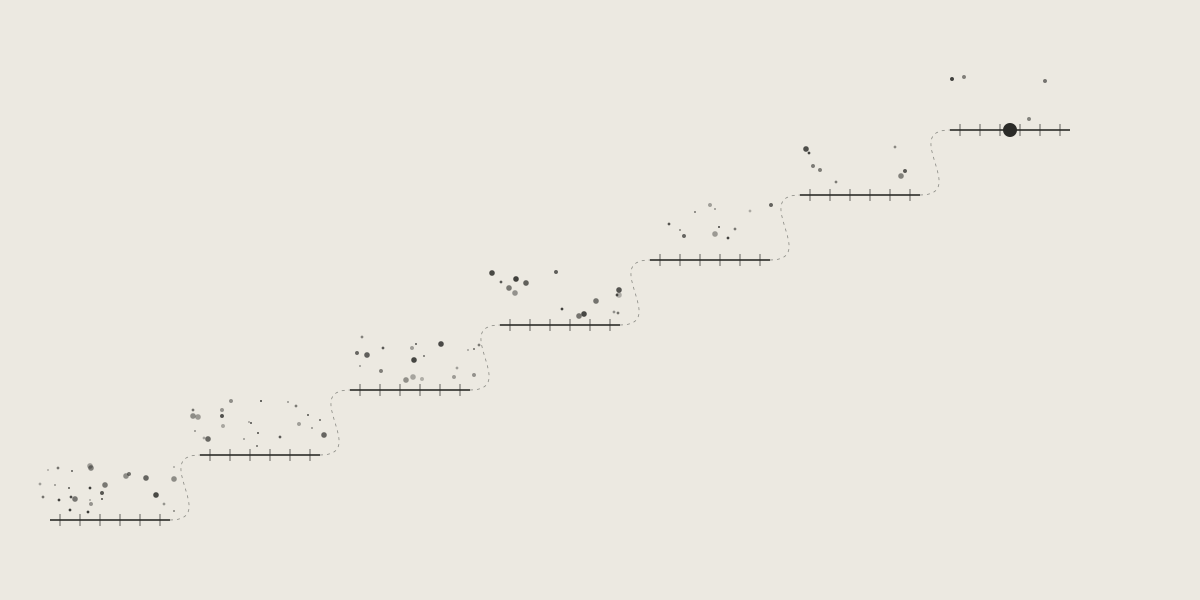
Six Birds answers this by doing it. On a fixed, frozen substrate, with exact arithmetic and nothing hidden up any sleeve, the papers build a new layer from scratch. Every step is a gate. Every gate keeps a record. The result is a ladder with seven rungs.
The ladder
- Witness. Something shows up. Observing the whole tells you things that tracking the parts separately would not. A difference that should not be there if the parts were the whole story.
- Anchor. The difference survives a battery of controls. It is not noise, not memory, not an artifact of how you looked.
- Promotion. Six tests, all of which must pass. The new description must be sufficient on what it claims to describe. Its update rule must not depend on which representative you picked. It must stay stable when you zoom out further. It must not smuggle anything in. It must be legible.
- Verdict. What kind of thing survived? Some candidates match every appearance and still fail, because they have no rule of their own for how they change. Matching appearances is not what earns the object.
- Carrier. Does the package own a native state space, a law for moving through it, and a way to read it out?
- Events. Happenings are admitted only as records with eight slots, binding a condition in the new layer to a public condition through an instrument that must declare what it hides.
- New layer. If the new structure cannot be reconstructed from the old layer's data, a genuinely new level exists.
Three things the ladder teaches
First, real is not a yes or no. It comes in grades and types. Some things are real outright. Some are real only under a particular way of comparing, and that comparison is part of the object, not a defect. Asking whether numbers, nations or minds really exist, without saying at which layer and in which lane, is a badly typed question. Most of the old disputes are between parties who never declared their lanes.
Second, a zero can be earned. When one paper's construction reached zero accepted events, the verdict was not disappointment. It was a name for the exact thing that was missing. That name is what let the next paper build it. Ignorance has structure, and the structure of what is missing is knowledge.
Third, old layers never die. When a new layer strictly extends an old one, the old one is neither refuted nor absorbed. It becomes the boundary condition that licenses its successor. Newton is not false. Newton is the boundary that licenses relativity. Reality, on this showing, is a palimpsest. Nothing that ever closed is struck from the books.
The persistence of the old layer is not a negative result. It is the condition under which the new layer is licensed.
That is the whole grammar of being real, in one worked example. Everything else on this site is that ladder, run somewhere new.
Drawn from To Worship a Stone with Six Birds: Reality as Closure, the philosophical companion to the Six Birds papers. The technical results it rests on are in the papers.