Papers · Preprint
Six Birds Verified XIII: Time, Charge and Currency
Energy drives time, is conserved, and is traded. Each of those links needs its own structure.
In plain words
In physics one quantity often plays three parts. Energy drives how a system changes in time, it is conserved, and it is the currency systems exchange. These are different kinds of object: an operator on states, a function on states, and an entry in a ledger at a boundary. The paper asks exactly what is needed to pass from one to the next. A skew factor makes a generator conserve a quadratic storage, and for nondegenerate storage these are all the conserving generators. The Cayley step, an exact rule for one discrete time step, conserves the storage exactly when the generator does.
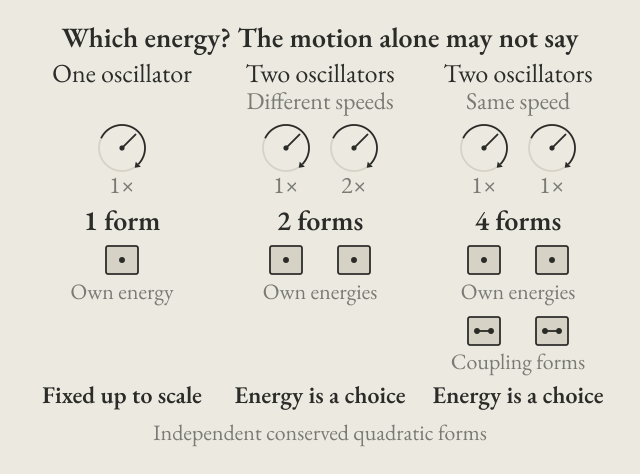
Adding ports turns storage into a ledger. Every midpoint step balances exactly, so the books add up over any run, and dissipation appears as a booked loss. Two coupled systems cancel their internal exchange for every output exactly when the coupling is skew. The generator does not always pin down its energy, though. Two oscillators at the same frequency have a four dimensional space of conserved quadratic forms, so which one gets booked as the energy is a choice. For several oscillators, the generator alone fixes the energy up to scale only when there is just one.
Everything is exact over the rational numbers, with no flows or limits. Six examples show each link failing when its structure is missing: a time action with no nonconstant conserved charge, a conserved charge with no way to transfer it, balanced postings with no state potential, and more. A separate example shows that a clock need not be a time action at all. Persistence has a price only under conditions. If every repair gains at least a fixed amount and at most a fixed multiple of its cost, there is a cost floor. If repair costs can fall like one over n, there is none. All results are formalized in Lean 4.
What it shows
- For nondegenerate storage, the conserving generators are exactly a skew matrix times the storage.
- The Cayley step conserves storage exactly when its generator does, and always exists for positive definite storage.
- Midpoint ledgers balance exactly; internal supply cancels for every output exactly when the coupling is skew.
- Coinciding frequencies enlarge the space of conserved forms, so the energy can be a choice.
- A conditional cost floor for persistence, and a family with no floor.
What it does not claim
It derives no physical law or constant, and does not identify its storages with the energy of relativity, quantum theory or thermodynamics. Everything is exact linear algebra over the rationals; no real trajectories are claimed. The cost floor holds only under its stated conditions.
Cite
Tsiokos, I. (2026). Six Birds Verified XIII: Time, Charge and Currency. Zenodo. https://doi.org/10.5281/zenodo.23097942