Papers · Preprint
Six Birds Verified III: When Audits Survive
Calling a coarse model robust hides several separate questions. This paper answers each one.
In plain words
Two phrases keep coming back in Six Birds Theory. A packaged object is robust. An audit survives coarsening. This paper makes both precise for finite random processes, such as Markov chains, and finds that neither is a single statement. Take a chain with two separate closed regions, each with its own resting distribution. Add a tiny bit of noise everywhere and the two merge into one. Yet the two old distributions are still nearly at rest, and a change that keeps the same pattern of allowed moves keeps two separate resting distributions exactly. One word, robust, covers three different verdicts.
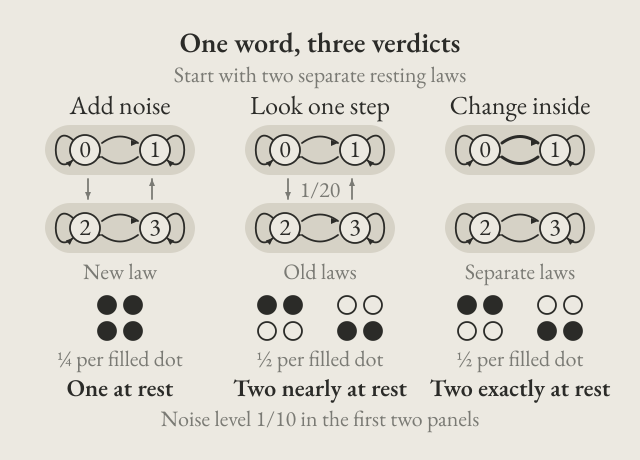
Part I gives each question its own answer. How close an almost fixed point is to a true one depends on how strongly the chain contracts. Two nearby chains share almost fixed points with no contraction needed, but bounding how far true fixed points move needs a contraction gap. The number of resting distributions equals the number of closed regions, and this number survives any perturbation that keeps the pattern of allowed moves. Several audits move by at most a stated multiple of the change, with constants that are attained or optimal.
Part II turns survival into a typed certificate. It names the audits, the transformation, what is held fixed and the rule for comparing old and new values. One merge of states can lose a distinction and gain a valid equation at the same time, so there is no single direction of improvement. Records of where things came from survive only as an append only log. All results are finite and exact, with Lean 4 formalizations.
What it shows
- Robustness splits into separate questions with separate, sharp answers.
- Several resting states can merge under arbitrarily small noise, yet their number survives any change that keeps the allowed moves.
- Survival under coarsening is a typed certificate, not a yes or no.
- One merge can make one audit worse and another better at once.
What it does not claim
It proves no infinite state perturbation theorem and no thermodynamic, entropy or causal arrow result. The Markov chain mathematics it uses is classical and credited as such.
Cite
Tsiokos, I. (2026). Six Birds Verified III: When Audits Survive. Zenodo. https://doi.org/10.5281/zenodo.23097914