Papers · Preprint · v3
To Throw a Stone with Six Birds: On Agents and Agenthood
Measuring agency without goals, utilities or a little person inside.
In plain words
An agent is treated as a theory object: a package maintained inside a description of the system, with a budgeted interface to the rest of the world. Agenthood is that package existing and persisting. Agency is its interface choices changing what happens outside.
Three computable measures make the distinction concrete: the viability kernel, the largest set of safe states that can always be kept safe affordably; feasible empowerment, how much affordable action sequences can say about a later outside variable; and the idempotence defect of a packaging map.
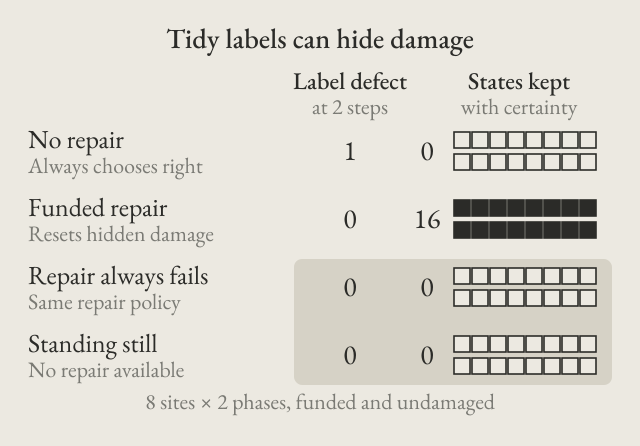
Two null tests guard against false positives: a system with a single action has zero empowerment, and an external schedule mistaken for an action shows a spurious 1 bit. In a small ring world, funded preventive repair drops the packaging defect from 1 to 0 and grows the set of states that can be kept coherent from empty to 16, though a zero defect alone does not identify maintenance. A phase dependent step raises median two step empowerment from 1.21 to 1.72 bits, and reducing slip raises it from 0.84 to 1.37. Lean 4 proves that the viability iteration reaches the greatest safe invariant set in at most as many removals as there are safe states.
What it shows
- Agenthood separated from agency.
- Three controlled comparisons in matched ablations, with two null tests.
- Hash traceable, deterministic experiments.
What it does not claim
No claim that any real system is or is not an agent.
Cite
Tsiokos, I. (2026). To Throw a Stone with Six Birds: On Agents and Agenthood. Zenodo. https://doi.org/10.5281/zenodo.23184176