Papers · Preprint · v2
Reflexive SBT and Anti-Localization
Global budgets can hide sharp spikes. Three auditable capacities that, when they vanish, rule the spikes out.
In plain words
Six Birds leans on accounting: budgets that bound total energy, work or dissipation. A budget like that can still allow a needle, a probe that piles almost everything into one tiny region. Needles force worst case bounds and undo the point of coarse packaging. This paper asks when packaging plus accounting rules them out. Its move, called Reflexive SBT, is to apply the six birds to the products of the analysis itself: the packaged subspaces, the dictionaries of allowed states, and the ladder of routes as resolution gets finer.
A localization number measures how much allowed energy can sit in one cell at a given scale. The paper bounds it by three auditable capacities. One measures how unevenly a subspace's projector sits on the diagonal. One measures how badly small groups of dictionary atoms are conditioned, since nearly cancelling atoms can build a needle. One applies the subspace measure to the span of all route outputs together. The main theorem is conditional: if these capacities vanish along a ladder of refinements, localization goes to zero.
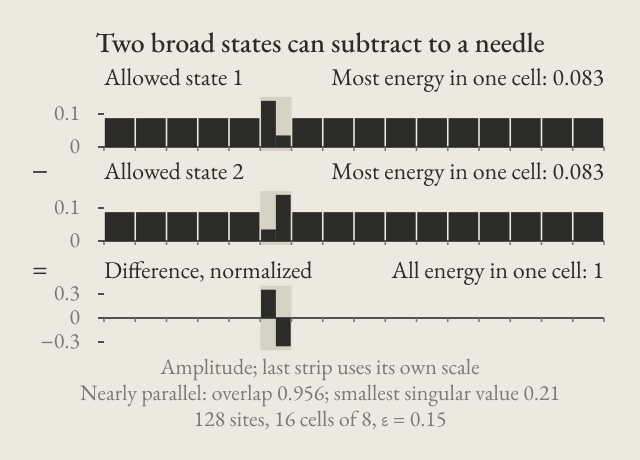
Controlled experiments back each failure mode. Shift invariant channels follow the predicted bound, while diagonal disorder pushes localization quickly toward its maximum. In the sampled dictionaries, needles appear only where small support conditioning is poor, and are absent in random baselines. Sequential and direct routes in spectral packaging agree when the cutoff has a spectral gap, and an inherited canonical selection rule makes them agree even at degenerate cutoffs. A closure loop lowers the targeted capacity for the subspace and dictionary failures, while a stuck route case keeps its capacity on the ledger.
What it shows
- A localization metric for packaged feasibility, computed by an eigenvalue method.
- Three capacity terms, each matched to a failure mode with an explicit counterexample.
- A conditional theorem: vanishing capacity implies anti localization along a ladder.
- A route agreement result for spectral packaging: agreement when the cutoff has a gap, and an inherited canonical rule for degenerate cutoffs.
What it does not claim
It does not prove that Reflexive SBT drives the capacities to zero in general. The step from capacity to anti localization is proved; the loop's reductions are shown only on controlled examples.
Cite
Tsiokos, I. (2026). Reflexive SBT and Anti-Localization. Zenodo. https://doi.org/10.5281/zenodo.23184180