Papers · Preprint · v3
A Six Birds' Eye View of Quantum Theory: Operational Closure Semantics for Measurement, Contextuality, and Record Stability
Collapse as packaging, not as physics.
In plain words
Quantum theory uses one object, the state, for two jobs: describing how a system evolves and keeping track of what has been recorded about it. Mixing the jobs makes collapse and Schrödinger's cat look like physical jumps.
The paper keeps them apart. One map evolves the system. Another, a packaging map, keeps only the distinctions a chosen record interface can hold. Packaging twice changes nothing.
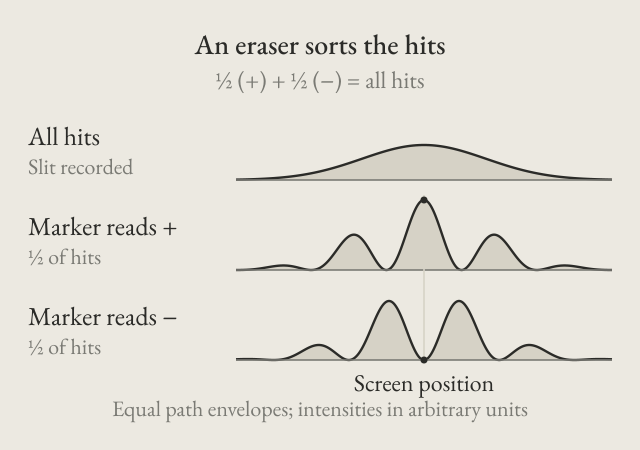
Dephasing in a record basis is such a map. Lean 4 proves that it is idempotent, trace preserving and completely positive, that full dephasing fixes exactly the diagonal states, and that dephasing only an apparatus leaves coherence in unmeasured registers. Deterministic simulations then show the bookkeeping: packaging fails to commute with generic evolution but commutes with evolution diagonal in the record basis; double slit fringes track the overlap of the which-path records; an eraser recovers fringes only by conditioning on a marker; and in a system, apparatus and environment model the global state stays pure while the record is a classical mixture.
What it shows
- Dephasing as idempotent packaging.
- Route mismatch as a computable diagnostic of measurement.
- A global state that stays pure while the packaged record is classical.
- A mechanized Peres–Mermin obstruction, kept separate from the order dependence of dephasing.
What it does not claim
No new physics is proposed; the paper reorganizes the standard account. It does not derive the Born rule, select a single outcome, or resolve Bell's theorem.
Cite
Tsiokos, I. (2026). A Six Birds' Eye View of Quantum Theory: Operational Closure Semantics for Measurement, Contextuality, and Record Stability. Zenodo. https://doi.org/10.5281/zenodo.23120465