Papers · Preprint · v3
To Plot a Stone with Six Birds: Constructing and Auditing Emergent Geometry from Markov Dynamics
Distance and curvature from a Markov chain, with no coordinates assumed.
In plain words
Points are groups of microstates under a lens. Distance is the cost of the cheapest chain of macro transitions, each step costing the negative logarithm of its probability. Nothing else is assumed, and the paper proves in Lean that this always gives a valid distance.
A layer counts as coherent when its closure, persistence, route and distortion defects all vanish along a declared refinement. The paper builds coherent layers for three systems: block lenses on a grid walk, whose distances converge to taxicab distance on the unit square; recursive cells on a Sierpiński gasket walk, converging to a self-similar fractal; and reservoir chains on the sphere, converging to the round sphere, whose curvature a landmark transport estimator recovers.
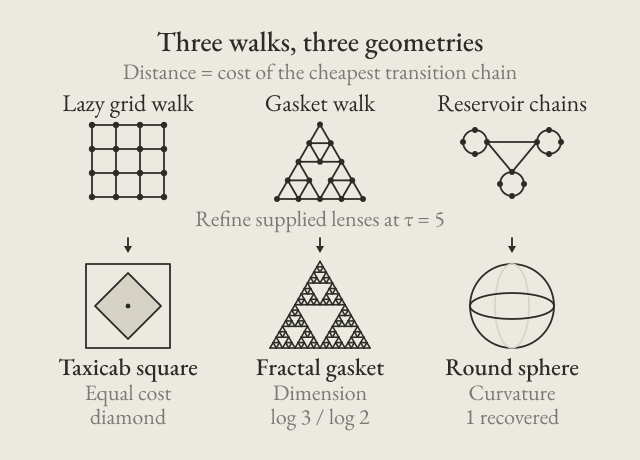
For the walk on the lattice, the cost of one long move converges to a quadratic form, so its square root is straight-line distance and Pythagoras becomes a statement about costs. The paper also marks the limits: spectrally learned lenses give valid distances but fail persistence, and a natural local estimator of curvature overestimates it by more than 20% even on exact spherical distances.
What it shows
- A distance built from transition costs alone, always a valid metric, proved in Lean.
- Coherent layers converging to the taxicab square, a Sierpiński gasket and the round sphere.
- A Pythagorean cost law for long moves of the lattice walk.
- Limits: learned lenses that fail persistence, and a curvature estimator that converges to the wrong value.
What it does not claim
Geometry here is a closure artifact of finite dynamics, not a claim about physical space.
Cite
Tsiokos, I. (2026). To Plot a Stone with Six Birds: Constructing and Auditing Emergent Geometry from Markov Dynamics. Zenodo. https://doi.org/10.5281/zenodo.23130783