Papers · Preprint
Physics by Constraint: From Consistency Conditions to Physical Claims
Where the step from a theorem to a physical claim actually happens.
In plain words
Many programmes in physics use consistency conditions to construct or select a theory, not only to check a chosen one. The step that matters most comes later: the passage from a bounded output, such as a theorem or an exact computation, to a claim about gravity, a coupling constant or a particle mass. That is where identifications are imported, models are calibrated and branch choices are supplied.
This paper is a comparative case study of documents. It codes 22 units and works through eight claim chains, and it records what each source presents, not whether the source is right. Six Birds is one of the programmes coded.
The first result is negative. A four part architecture of carrier, permitted operations, closure like condition and physical output fits 21 of the 22 units, including all four established comparators and an ordinary control. So that architecture does not mark out recent programmes from their antecedents, and the paper withdraws an earlier draft's label for such a field.
The second result is about bridges. Seven of the eight chains carry ten bridge components between them, one of which, in a Six Birds chain, is a proposed bridge that the computation excludes. One chain needs no bridge inside its stated scope. A theorem's status tells you little about the support it gives a physical claim: two peer reviewed theorems can end in very different places.
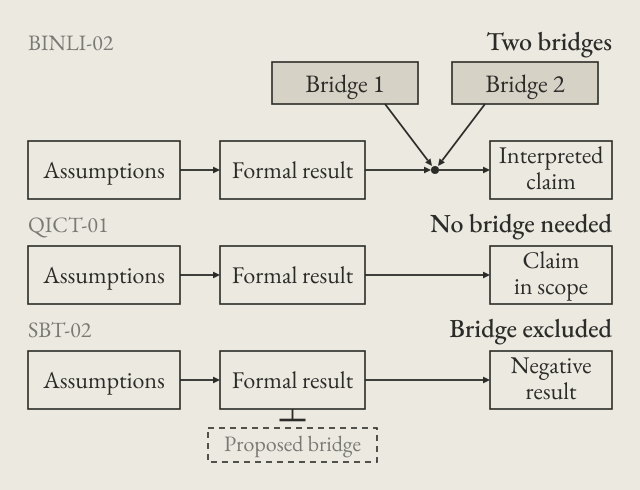
What it shows
- A negative discrimination result for the four part architecture.
- A simple dependency notation that keeps formal output, bridge assumptions and physical claim apart.
- Rerunning a computation checks what that computation reaches, and stops before the physical identification.
- A way to keep a negative result from being read as a validation or a defect.
What it does not claim
It is not a systematic review, a survey or a validity assessment. It establishes neither programme validity nor prevalence, audits no proof and reproduces no computation. The coding was done by language model agents under human management, no programme author has reviewed their description, and nothing here validates any coded programme, including the author's.
Cite
Tsiokos, I. (2026). Physics by Constraint: From Consistency Conditions to Physical Claims. Zenodo. https://doi.org/10.5281/zenodo.22223833