Papers · Preprint · v2
Holonomy with Memory in Six Birds Theory: Predictive Quotients, Witnesses, and Fixed-Support Route Transport
Two histories can look the same right now and still predict different futures. This paper makes that gap exact.
In plain words
Imagine two paths that arrive at the same place. From where you stand, they are the same. But one carries a memory the other does not, and that memory changes what happens next. The paper builds a careful frame for this. At every interface it defines two ways to group histories. One by what is seen now. One by what they predict later.
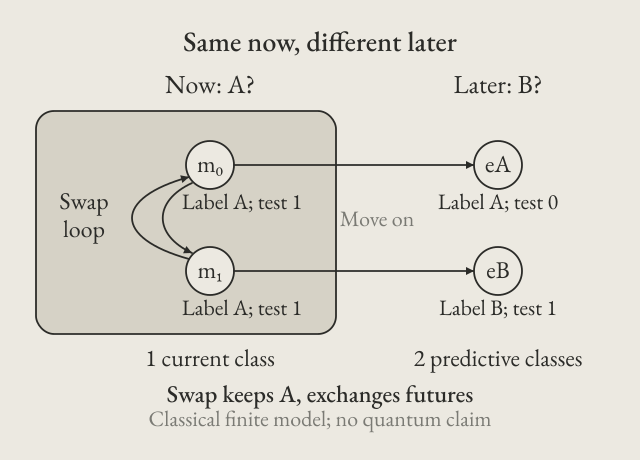
The prediction grouping is always at least as fine as the present grouping. When the two agree, the interface is flat and the past does not matter. When they differ, there is a witness: a pair of histories that match now and split later. Moving forward along the allowed steps is always well defined on the prediction grouping, and on the present one exactly when a step keeps together the histories that look the same now. A loop can leave everything visible unchanged while swapping two predictive groups, and any such swap forces a witness.
These are standard quotient constructions, in the spirit of Myhill–Nerode and predictive state models. The paper's contribution is assembling them for route transport, checking the theorem spine in Lean 4, and putting them to work on exact finite models run with rational numbers. Nine benchmark models separate six regimes, from flat behaviour to a coherent memory candidate in which one loop swaps two predictive classes, and small searches find further coherent candidates while a control search space stays flat.
What it shows
- Future equivalence refines present equivalence, and the gap has a witness.
- A step transports present classes exactly when it preserves present equivalence.
- The theorem spine is checked in Lean 4; the finite benchmark catalogs are exact but not formalized.
What it does not claim
It does not derive quantum amplitudes, interference or the Born rule. It works at the level of groupings and finite models.
Cite
Tsiokos, I. (2026). Holonomy with Memory in Six Birds Theory: Predictive Quotients, Witnesses, and Fixed-Support Route Transport. Zenodo. https://doi.org/10.5281/zenodo.23120494