Papers · Preprint · v2
Hiddenness as a Structural Law of Emergence
Once the machine's internal state shows in what you can see, no change can alter the future while leaving the present untouched. The hidden information is still there.
In plain words
When does seeing more of a computation's past add something to what you can see now? This paper studies finite sets of histories made by a procedure with an internal state, and groups them two ways: by tests that read only what is visible now, and by tests that may also read witness and continuation data. Exposure means some current test reads a part of the internal state that actually varies.
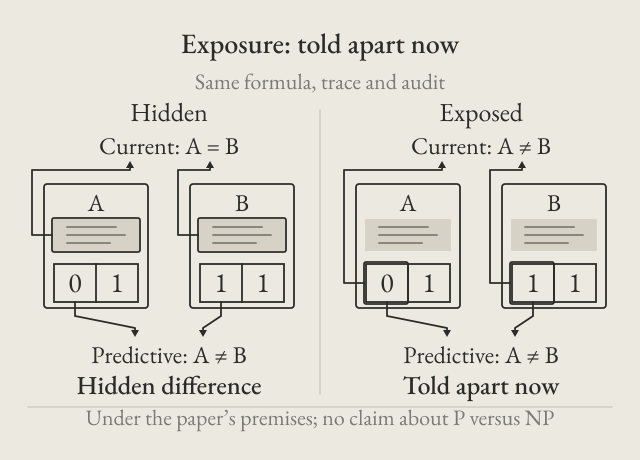
Under six stated premises, the main lemma has four clauses. With exposure, no loop can change what a history predicts without also changing what it shows now; the predictive grouping can still be finer. Without exposure, and with predictive witness content, some loop does change the prediction unseen. Without witness content the two groupings agree, and which branch holds depends on exposure, not on how strongly the procedure couples to its state. The clauses are short consequences of the premises; the contribution is their formulation, not a derivation of the premises for any class of algorithms.
A second theorem is a minimal example: two histories with different predictions and the same current view give the same yes or no outputs, so the difference can vanish when one passes to outputs. No link to P and NP is built.
What it shows
- The Candidate Structural Law: four clauses proved from six stated premises.
- Exposure as the single predicate that decides between the branches.
- A minimal example where a predictive difference disappears in the outputs.
What it does not claim
Nothing about P and NP. The premises are assumed, not derived for any class of algorithms, and the law holds on finite carriers that meet them.
Cite
Tsiokos, I. (2026). Hiddenness as a Structural Law of Emergence. Zenodo. https://doi.org/10.5281/zenodo.23086991