Papers · Foundations · v3
Six Birds Foundations II: Admissibility, Meta-Theory, and the Exact-Six Program
Fixing what the six roles mean, and proving no seventh is needed under a stated hypothesis.
In plain words
Foundations I introduced six closure roles. This paper makes them precise: their levels, local boundaries and selected lifts.
Honest bookkeeping, non collapse, activation thresholds and empirical bridges are stated as admissibility conditions: rules for when a claim counts. That is the admissibility regime.
On the domain of finite audited typed closure descriptions, the paper proves that each of the six roles occurs. Every description has a record with exactly six channels, a count built into the record's definition. The upper bound is conditional: under a stated recognition hypothesis, which some descriptions in the domain fail, no seventh irreducible role is required.
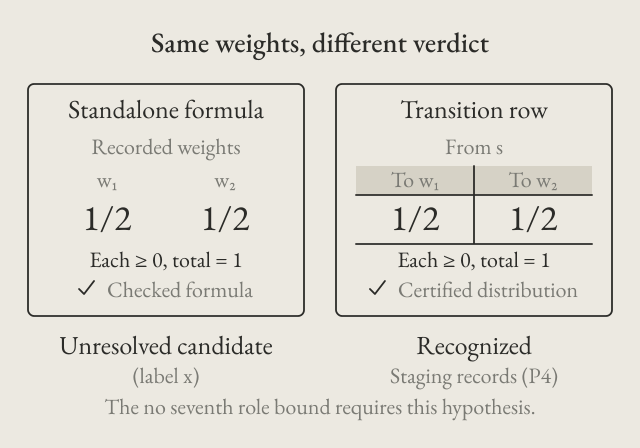
What it shows
- A primitive role architecture for P1 to P6.
- Six role lower bound witnesses.
- A decomposition theorem with exactly six channels, in the covered scope.
What it does not claim
No unrestricted exact six claim, no full algebra of primitives, no empirical realization.
Cite
Tsiokos, I. (2026). Six Birds Foundations II: Admissibility, Meta-Theory, and the Exact-Six Program. Zenodo. https://doi.org/10.5281/zenodo.23096828